Older news items
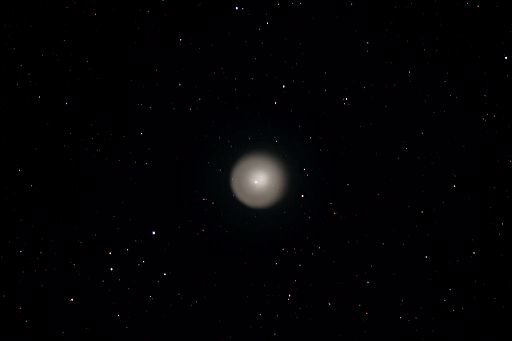
C/2017 O1 (ASASSN) past perihelion
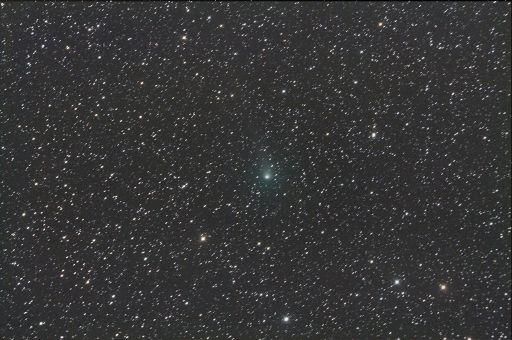
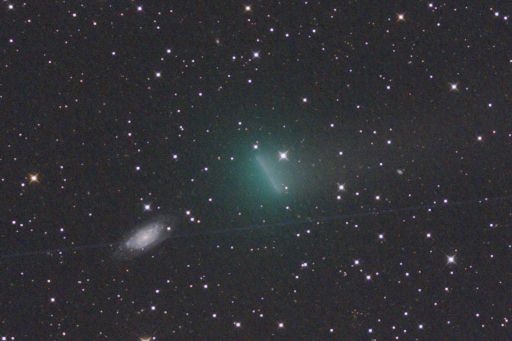
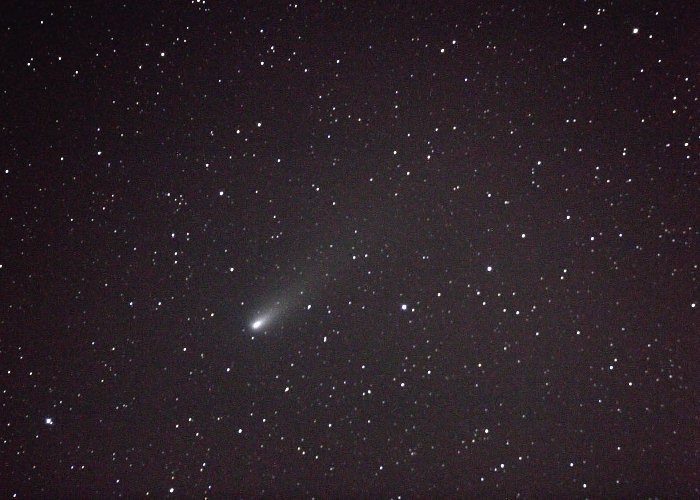
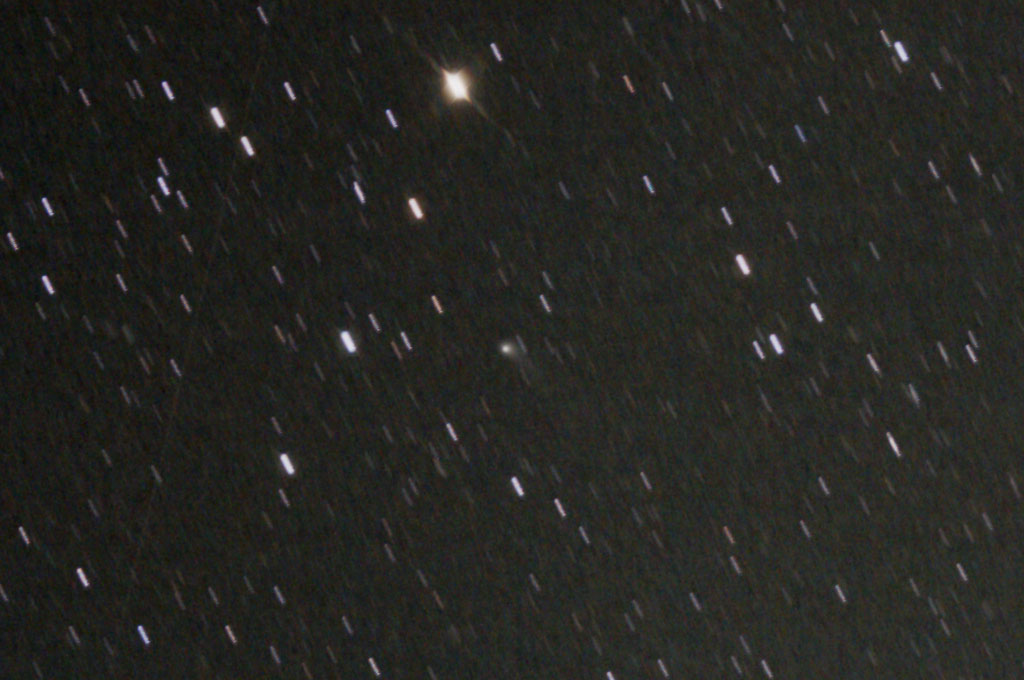
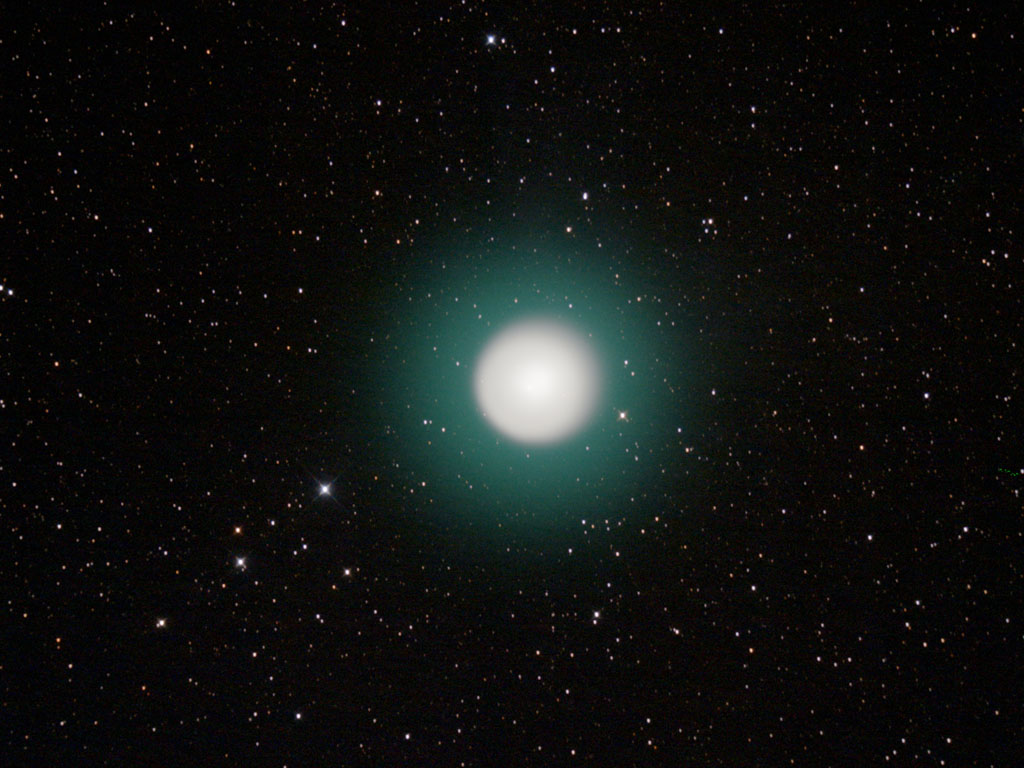
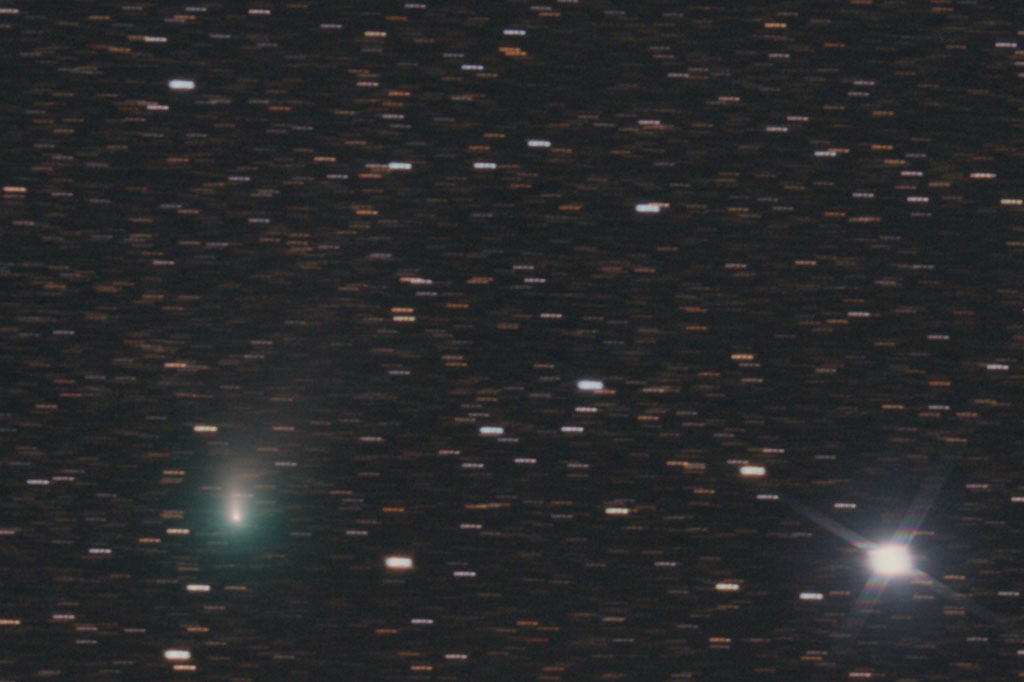
This comet, discovered on July 19, 2017 by the ASAS-SN patrol operated at the Cerro Tololo Observatory in Chile, was apparently in a small
outburst at the time reaching 10th magnitude a few days later. Unfortunately it has hardly brightened since, and is now well past its peak of 9th magnitude.
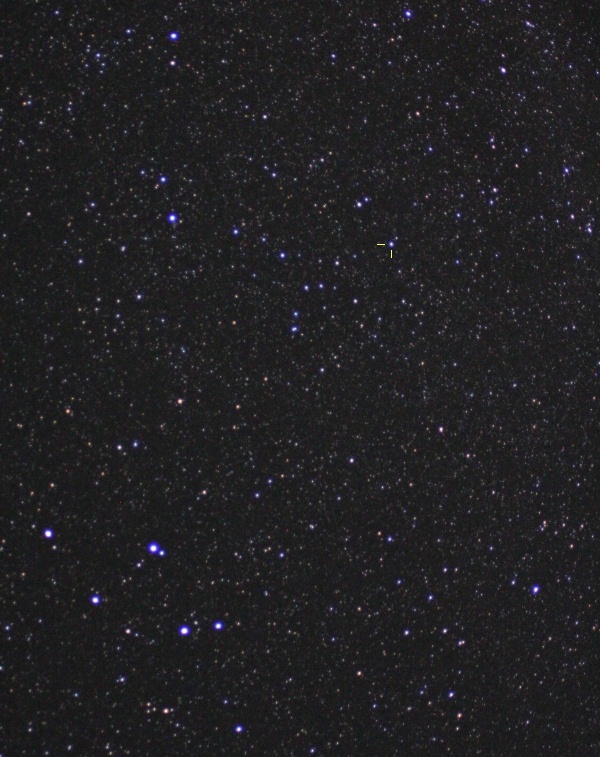
It passed perihelion on October 14 at 1.499 AU and is very well placed for northern hemisphere observers over the coming weeks, moving slowly in Cepheus,
only 3-4 degrees from Polaris.
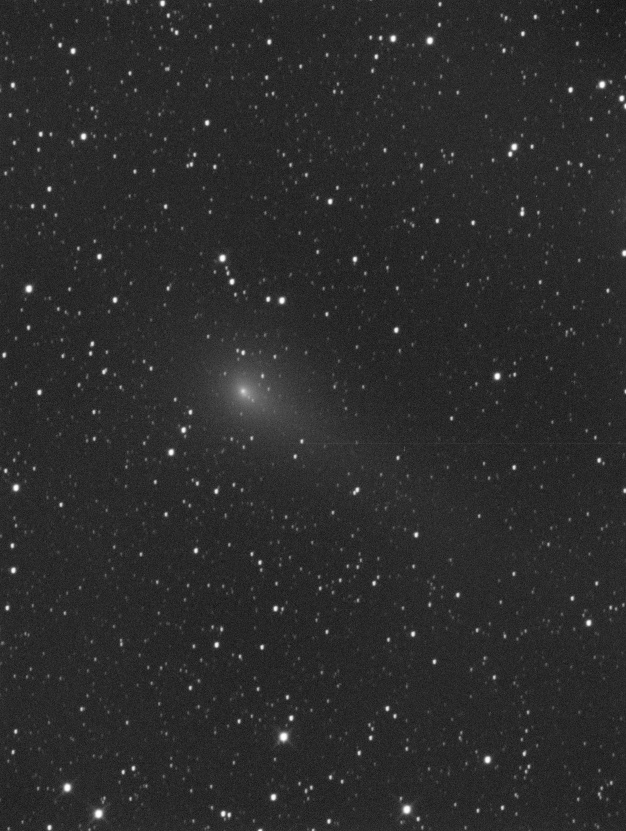
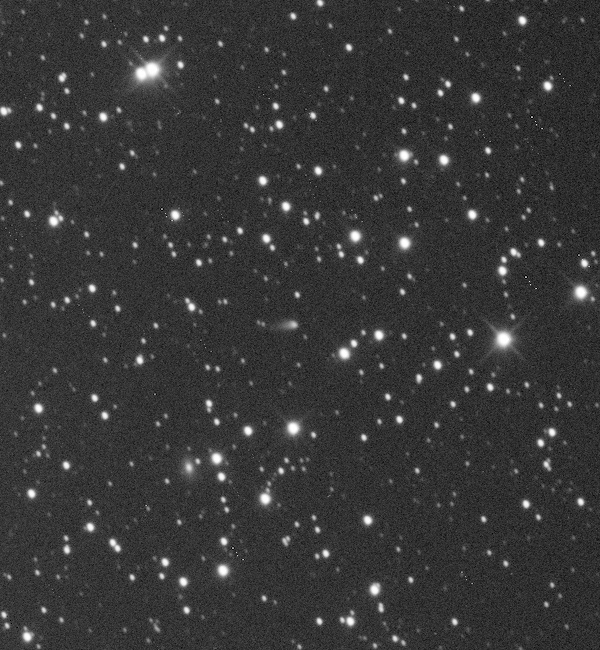
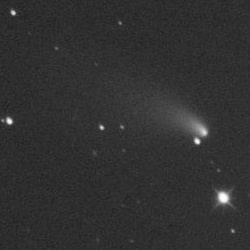
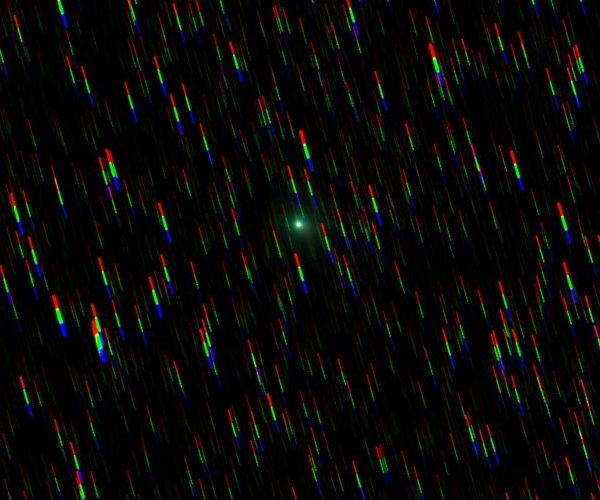
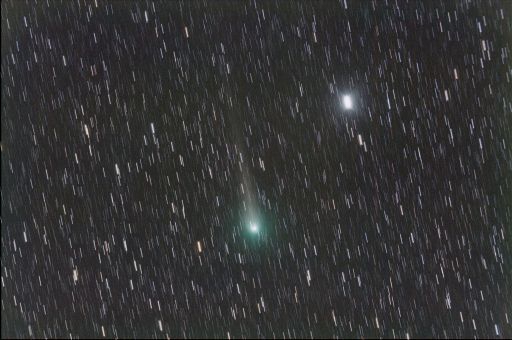
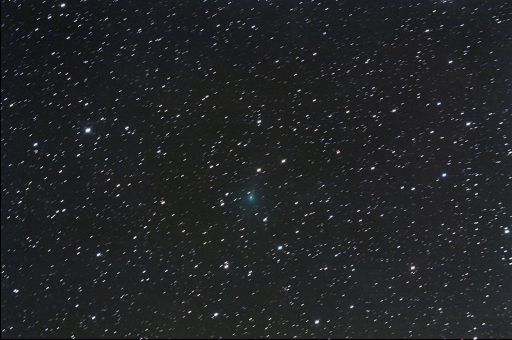
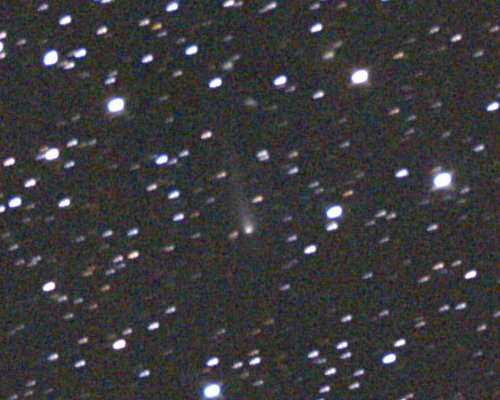
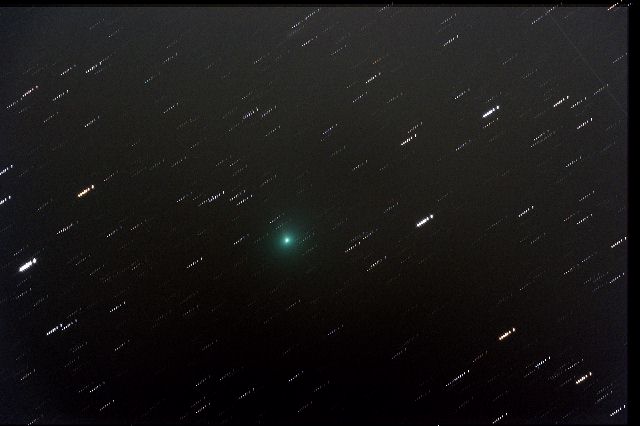
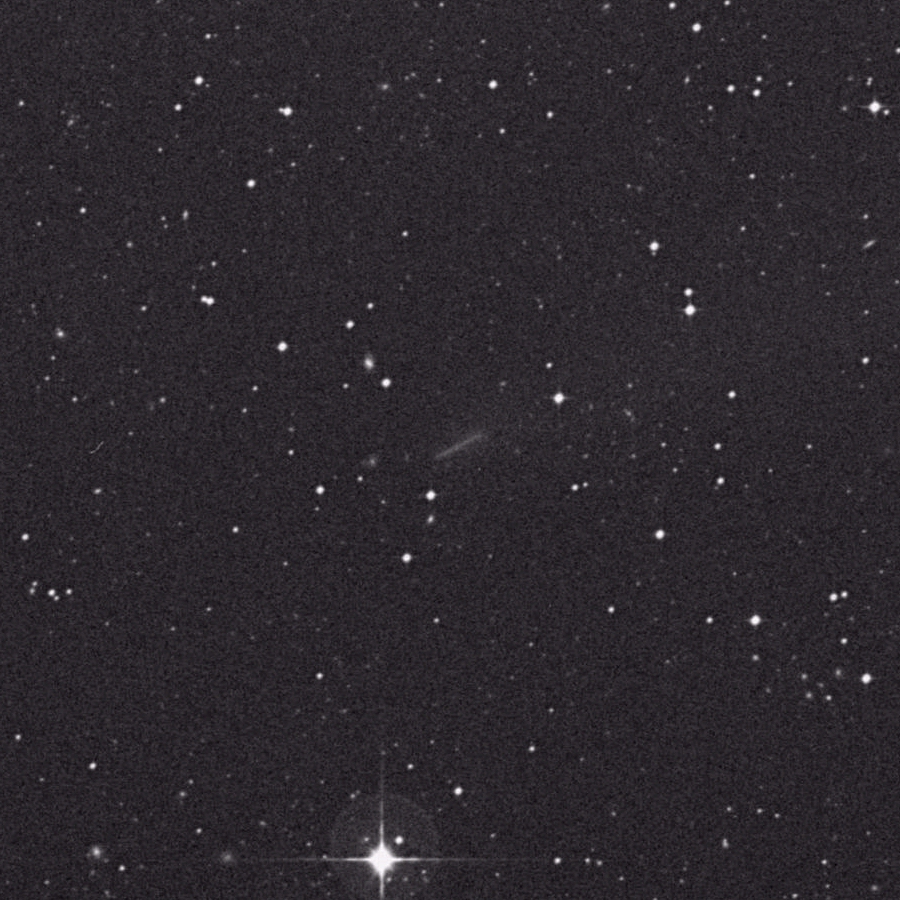
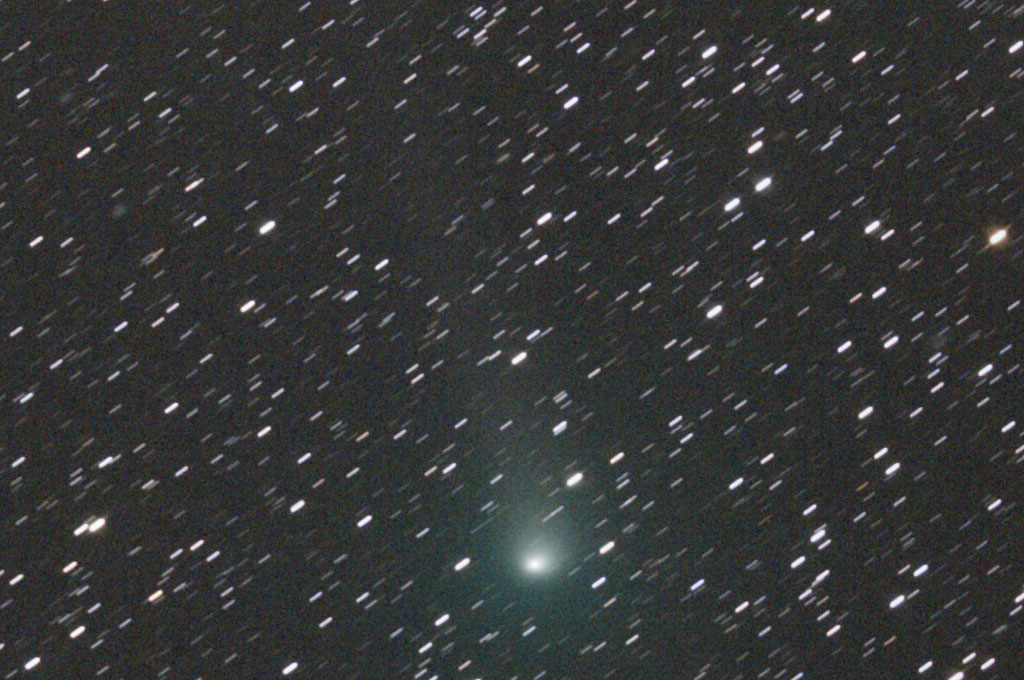
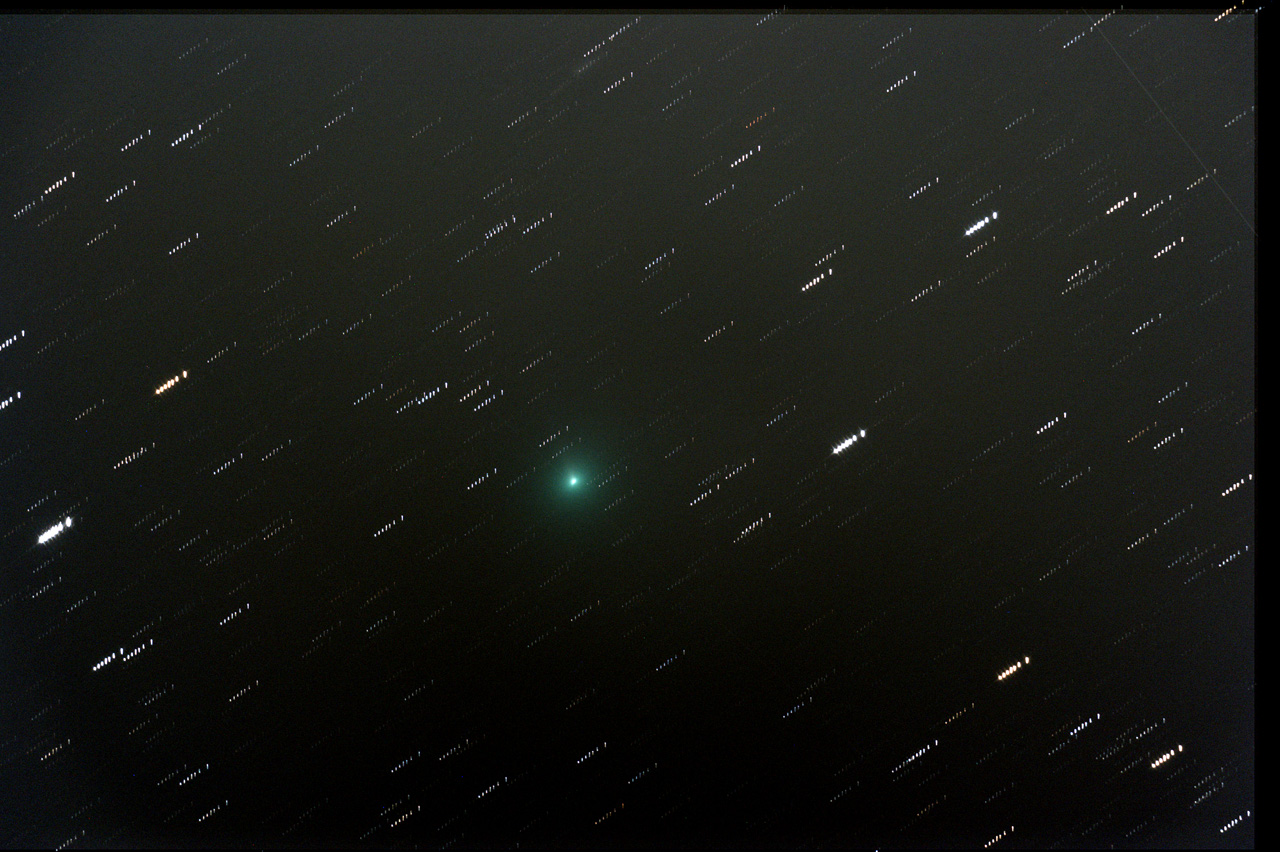
The (binned) image to the right is a single 3m (test) image obtained on October 15, starting at 22h25m UT, by Albert van Duin. He observed from
Burlage with his 40cm reflector.
The telescope was moved there recently from his backyard observatory in Beilen, and can now be operated remotely under much darker skies.
Undoubtedly more and better images to follow soon!
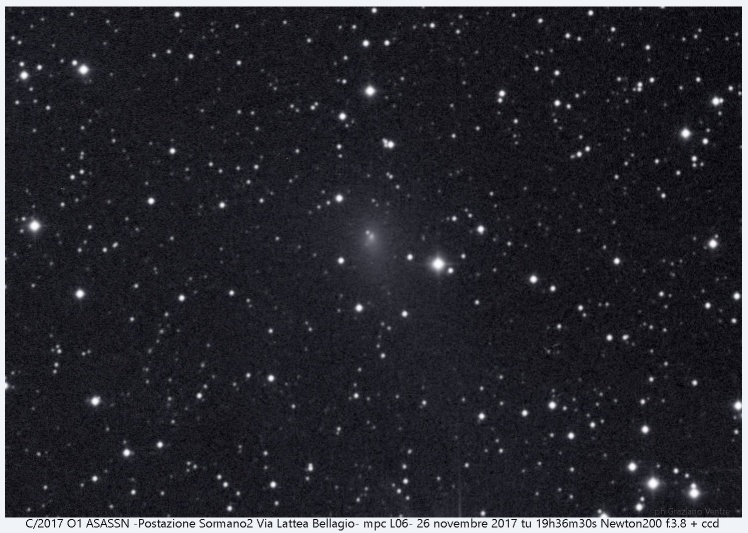
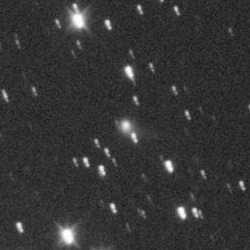
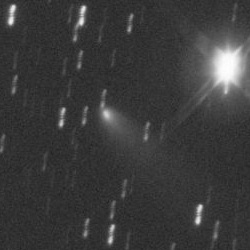
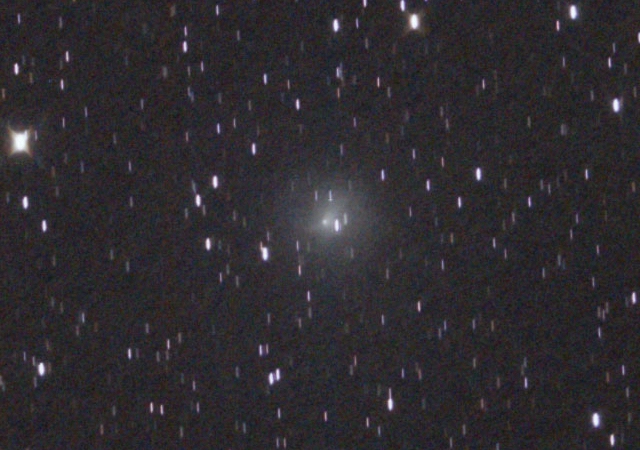
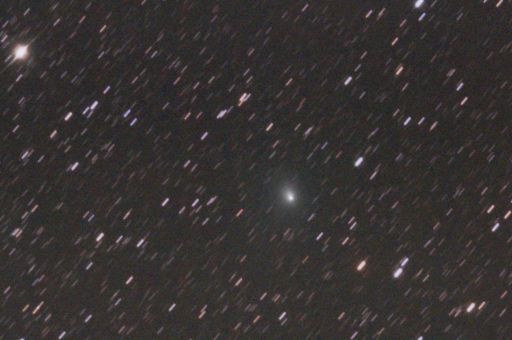
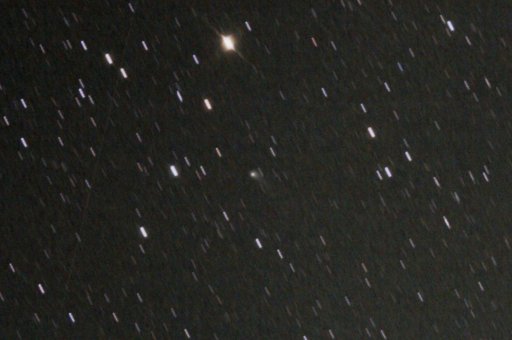
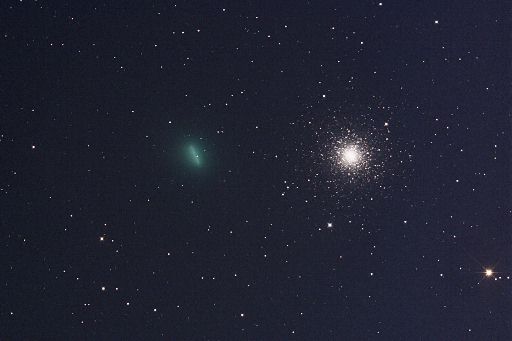
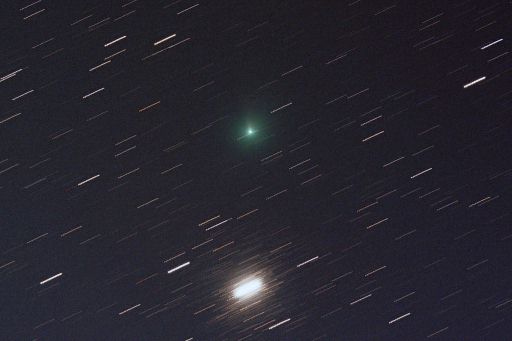
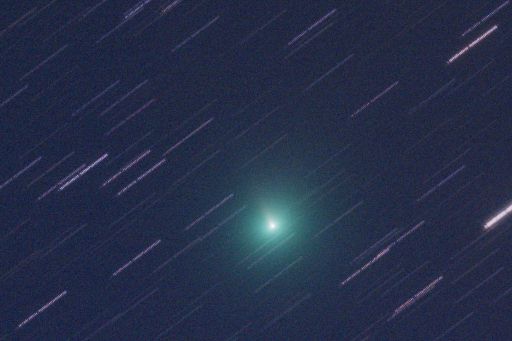
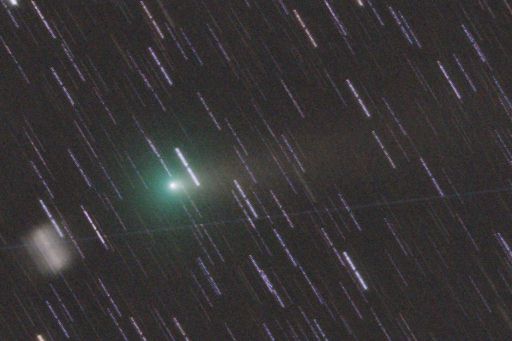
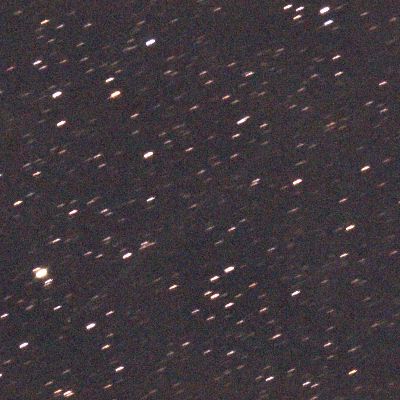
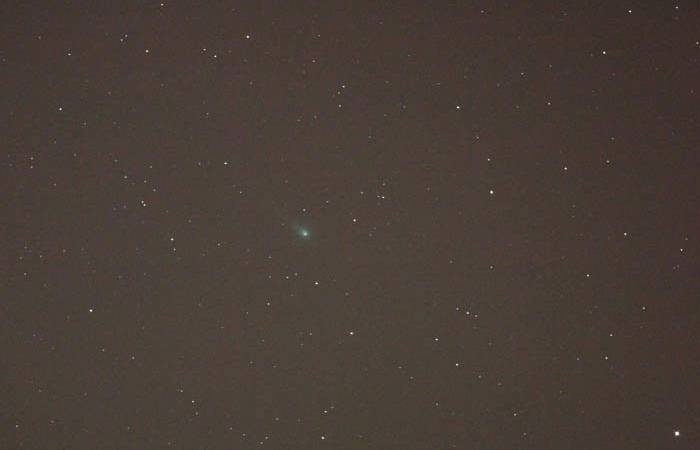
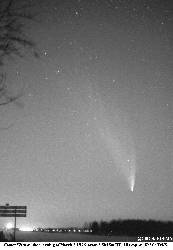
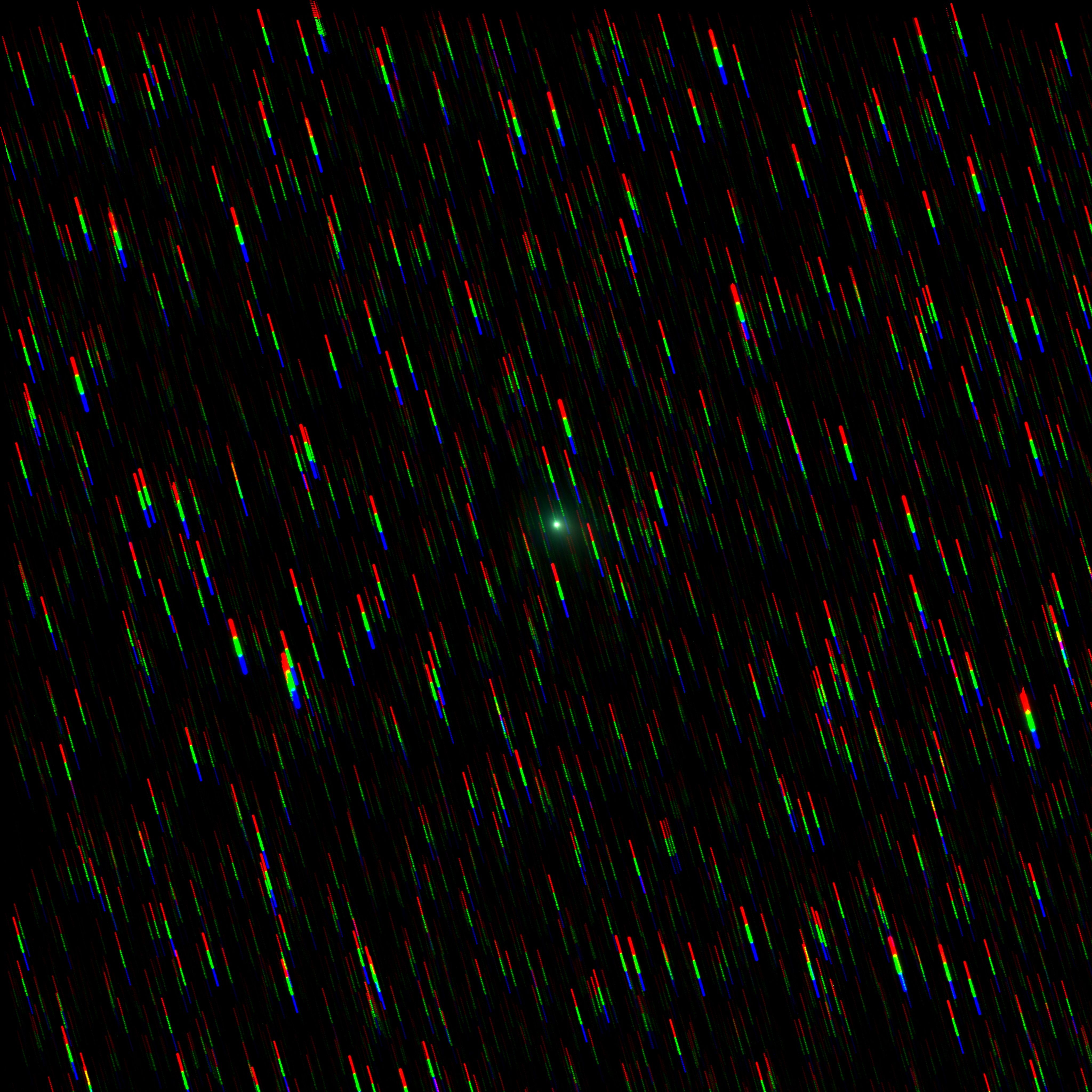
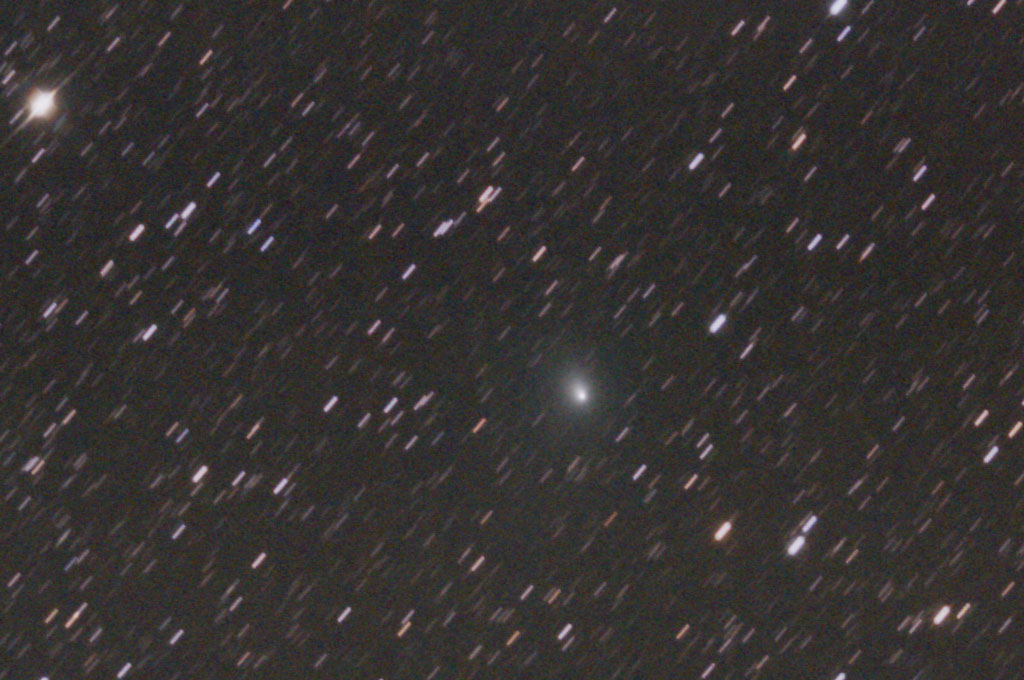
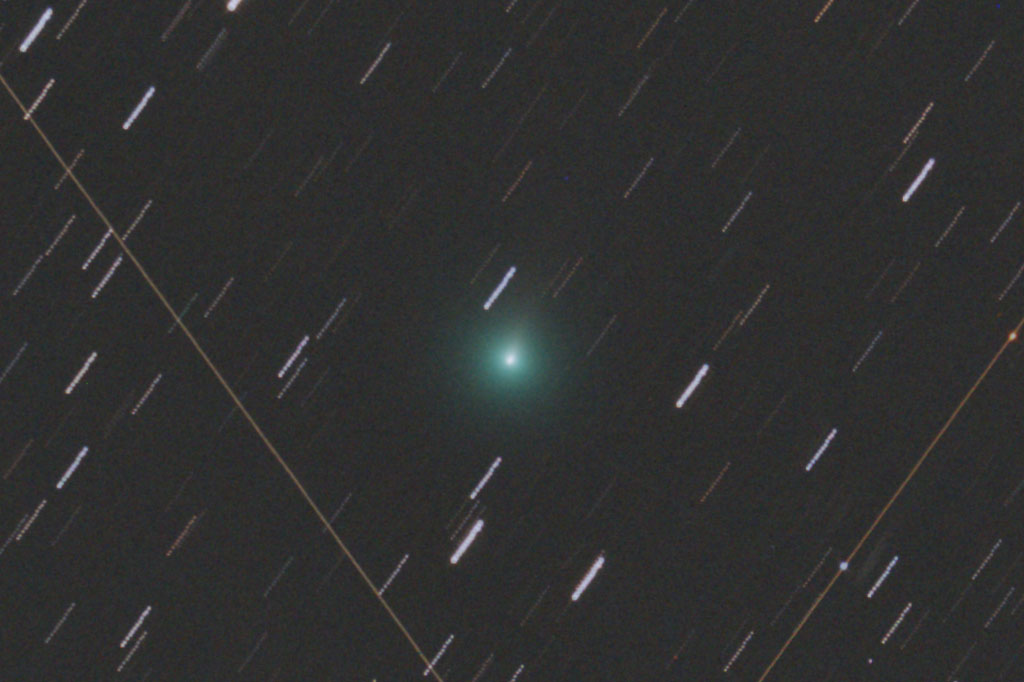
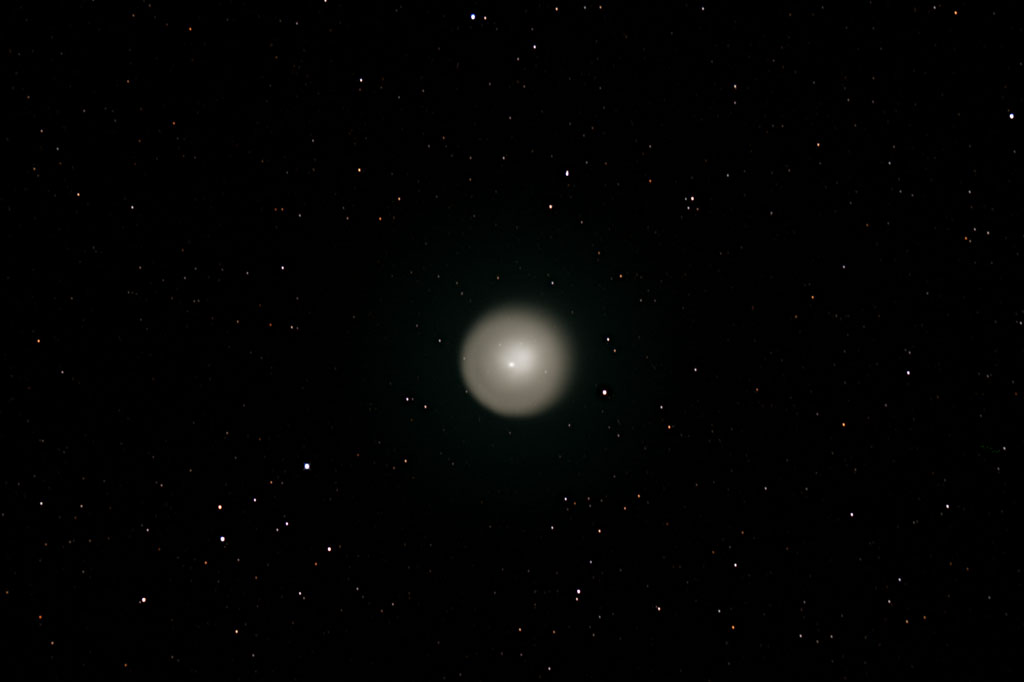
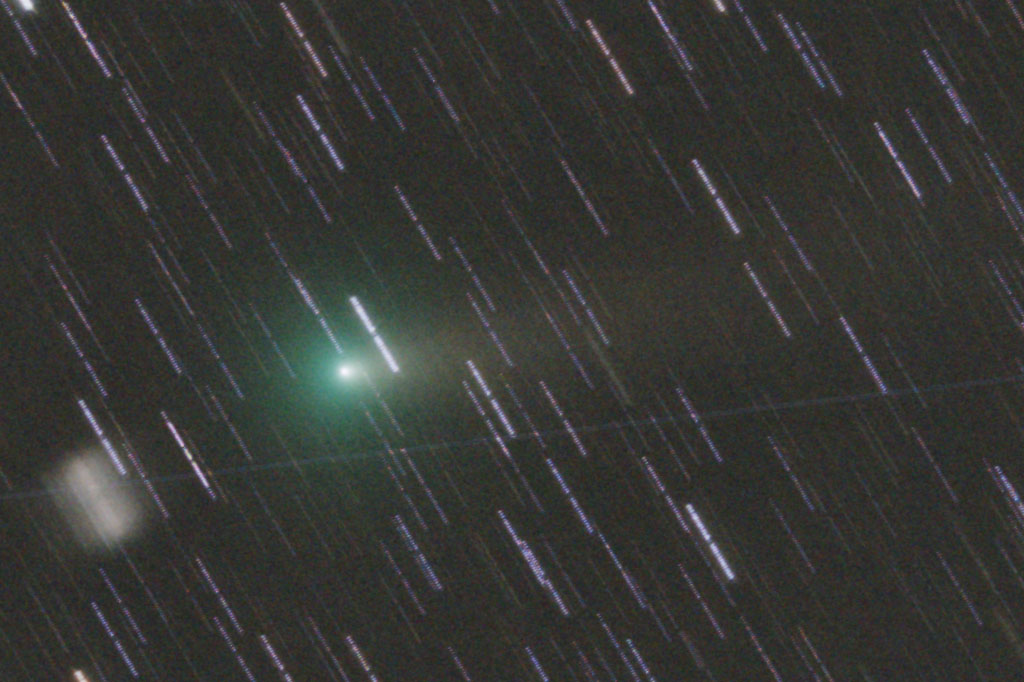
The second (binned) image, provided by Sandro Baroni from Milan, was obtained by Graziano Ventre on November 26 from Sormano, Italy.
Full details are shown on the image.
|
|
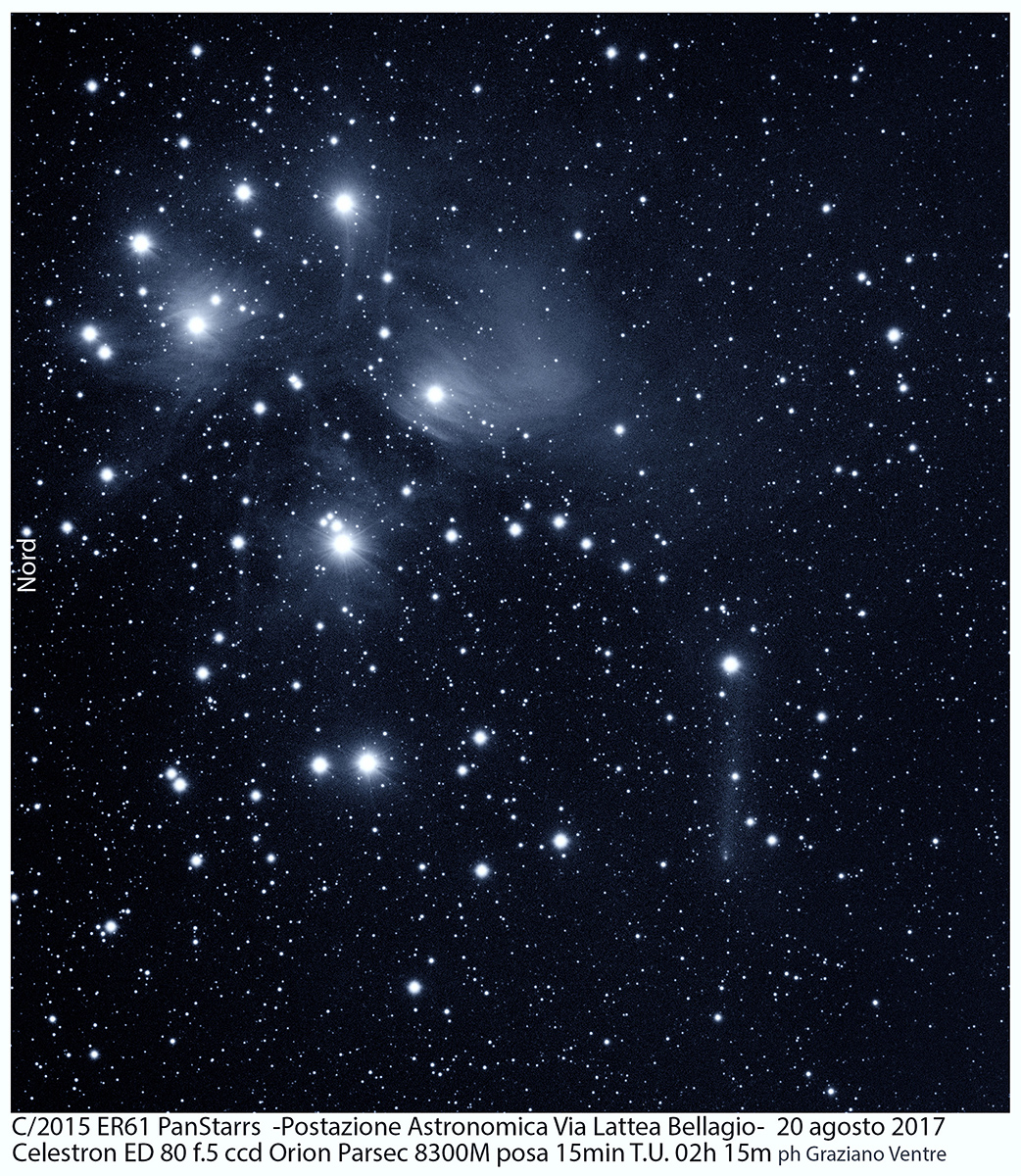
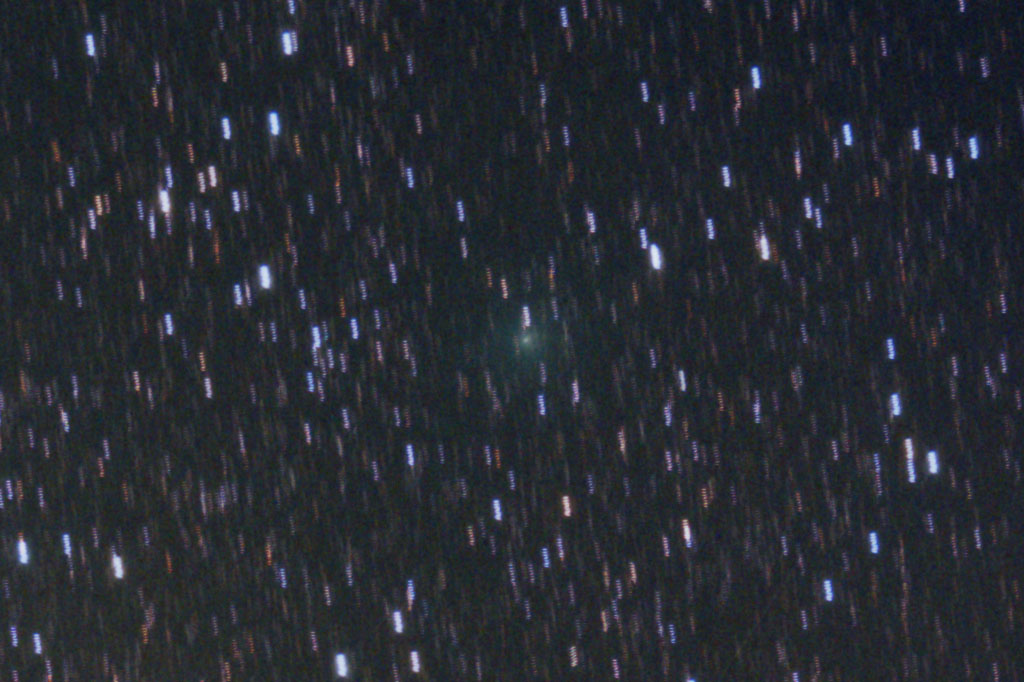
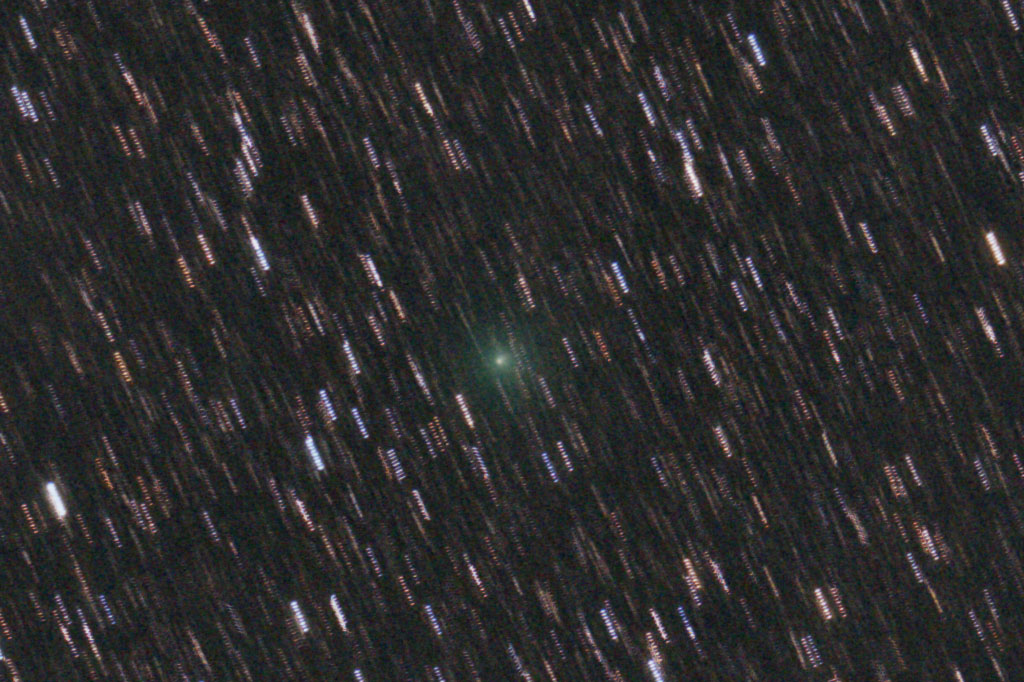
C/2015 ER61 (PANSTARRS) near the Pleiades
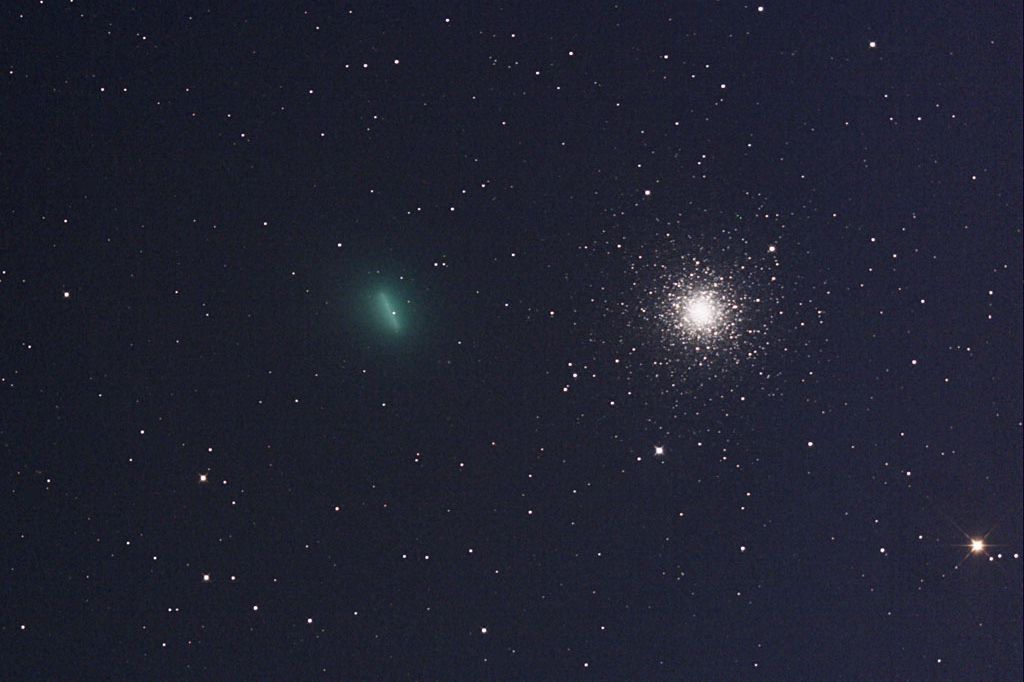
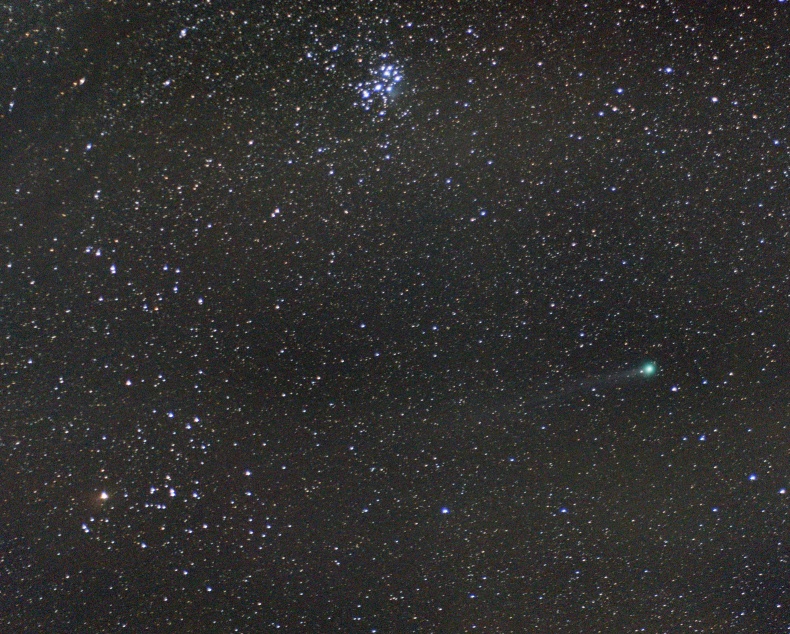
This comet, discovered in March 2015 as an asteroidal object of 20th magnitude by the PanStarrs survey, more than 2 years before perihelion
passage in May 2017 at 1.04 AU, peaked at 6th magnitude in April after a small brightness outburst while being best observable from the southern hemisphere.
In the meantime it is down to magnitude 13, but is easily located moving slowly near the Pleiades (M45).
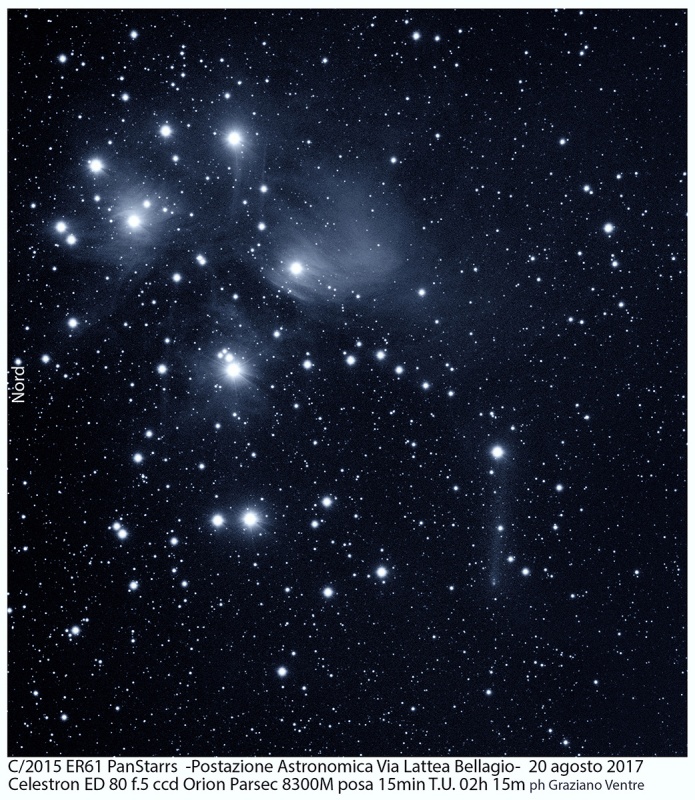
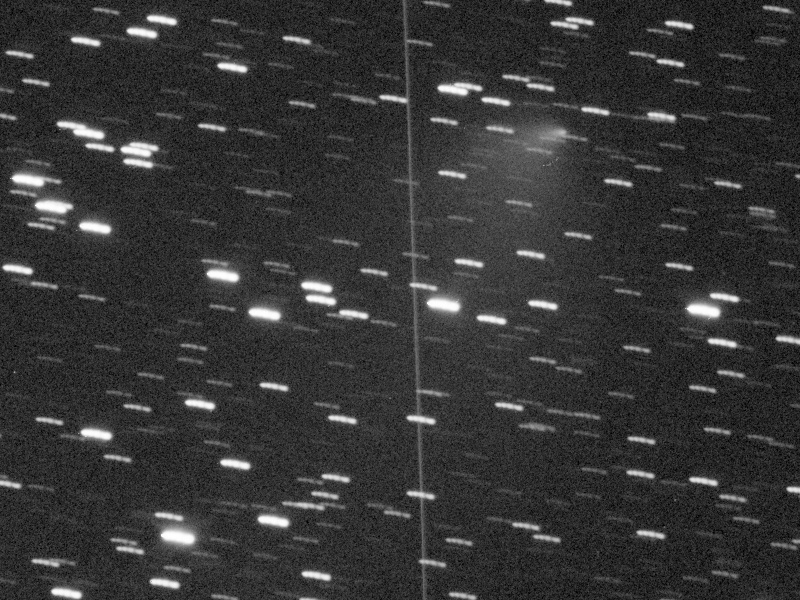
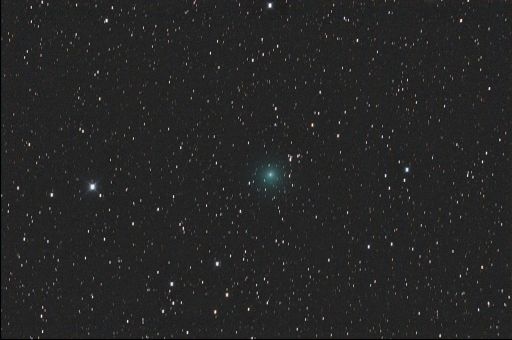
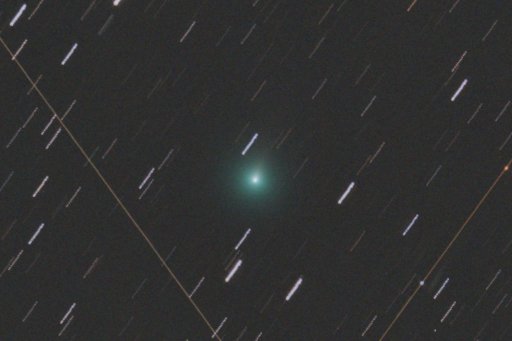
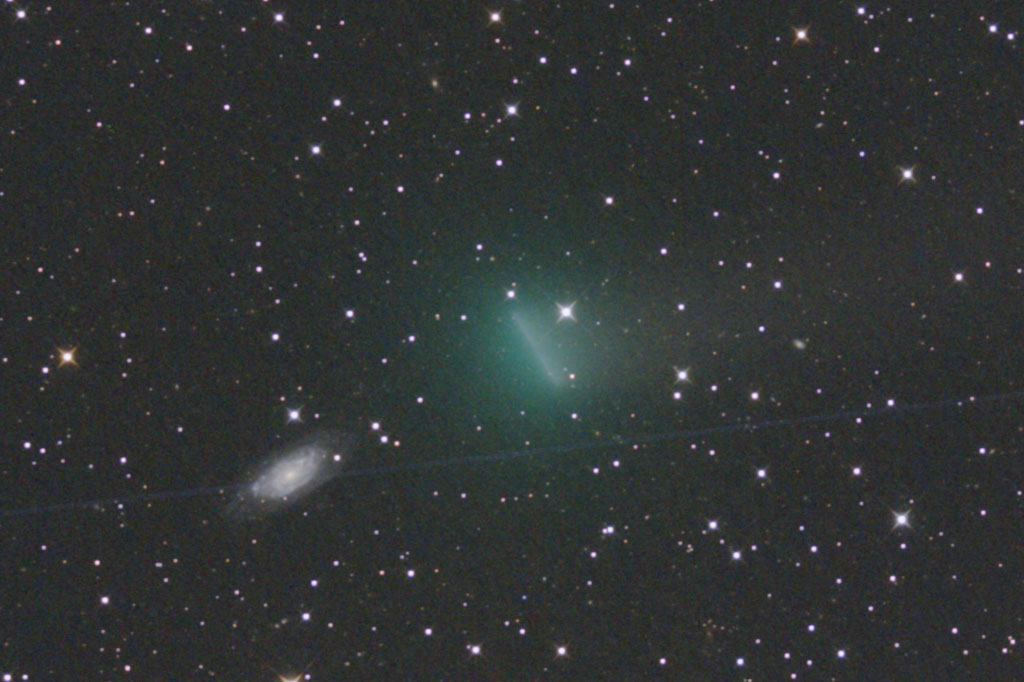
The (binned) image to the right was provided by Sandro Baroni from Milan, Italy. It was obtained by Graziano Ventre in the night of 20 August 2017.
Full details are given on the image.
Note the long thin dusttail!
A larger version of this image can be viewed by clicking here.
|
|
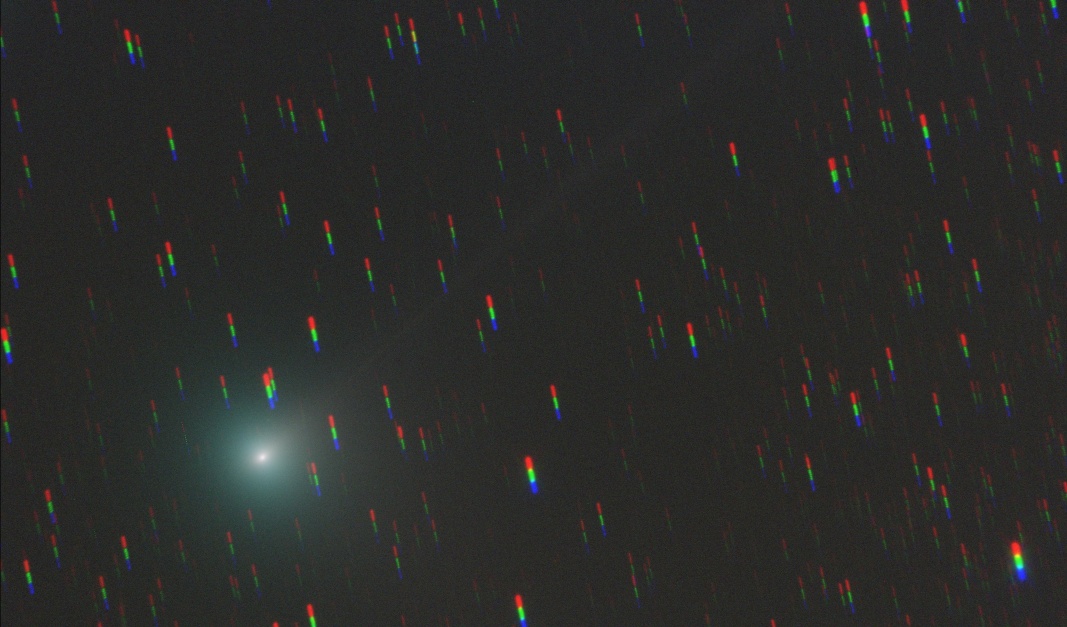
C/2015 V2 (Johnson) brightening
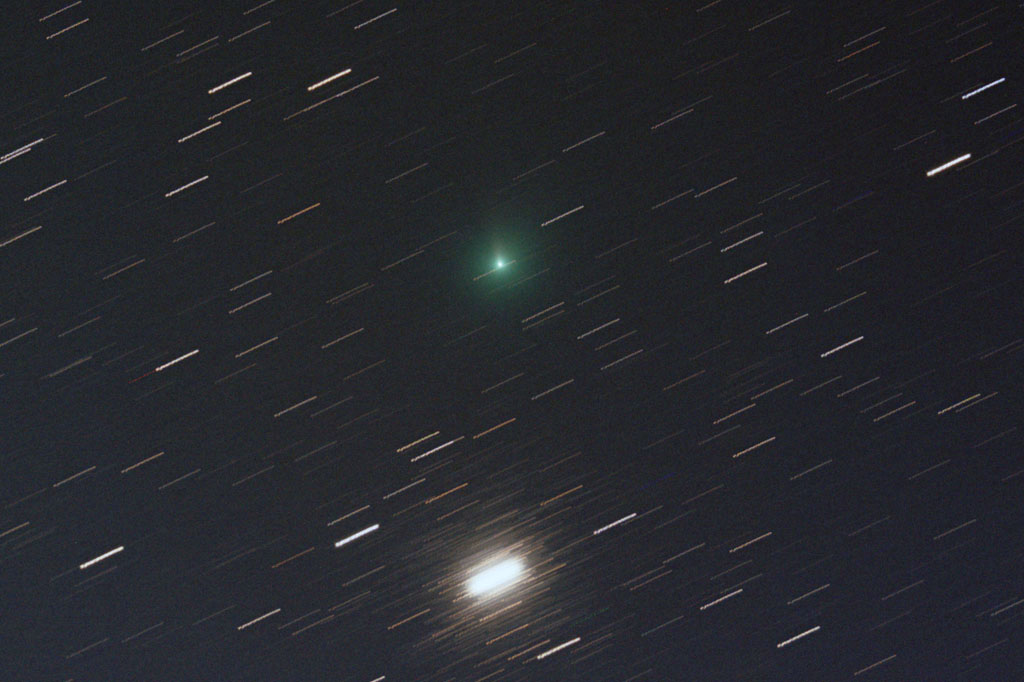
This comet, discovered in November 2015 by J.A. Johnson as a magnitude 17 object in the course of the Catalina Sky Survey,
has been gradually brightening since, and is now well visible in binoculars at 7th magnitude, moving south through Bootes.
The apparition is very favourable for observers worldwide with perihelion near oppostion on June 12, 2017 at 1.637 AU, reaching its closest
distance to the Earth at 0.811 AU only a week earlier.
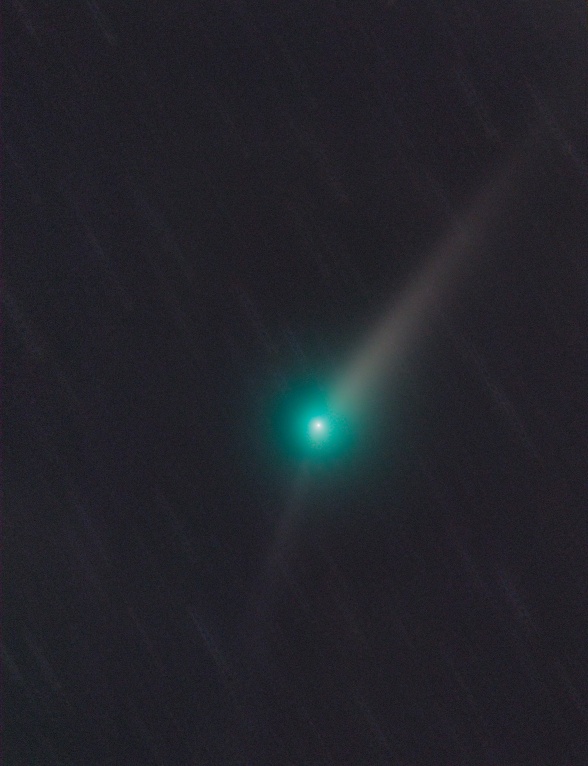
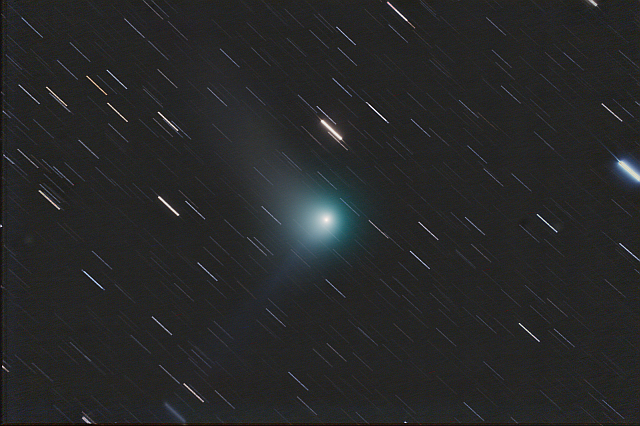
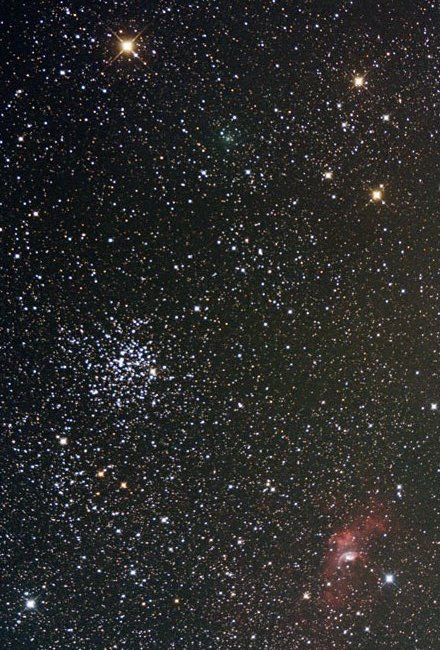
The (4x4 binned) RGBL image to the right was obtained in the night from 25 to 26 May by Emiel Kempen with a 25cm f/3 newtonian reflector
equipped with a SXVR-H18 CCD-camera.
It was composed from 59 120s exposures (10R,10G,9B,30L) taken between 21h52m and 00h54m under excellent conditions.
The image clearly shows, besides a fairly extended greenish coma, a bright dust tail and a faint gastail.
Over the coming week C/2015 V2 will continue to slowly brighten probably reaching magnitude 7 in the first weeks of June.
|
|
Comet 2014 Q2 (Lovejoy) at its brightest
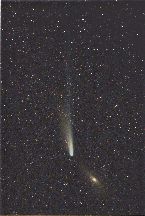
This image shows this comet near its brightest at magnitude 4 and well placed for both Northern and Southern Hemisphere observers, moving
rapidly north through Taurus into Aries. It was taken by Albert van Duin from his observatory in Beilen on January 14 around 17h30m UT.
It is a stack of 9 10s-images with a modified Canon 5D MKII at ISO1600 equipped with a 50mm/f1.7 Pentax lens. This is a 4x4 binned crop of
the original image.
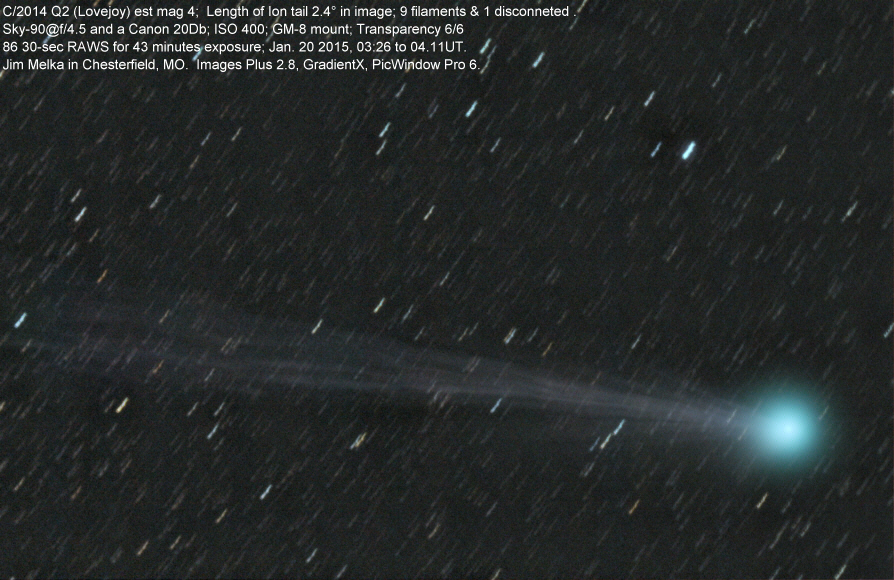 This image was taken early on January 20 by Jim Melka from Chesterfield, MO, showing quite a bit of detail in the gastail.
Further details are on the image.
This image was taken early on January 20 by Jim Melka from Chesterfield, MO, showing quite a bit of detail in the gastail.
Further details are on the image.
Over the coming weeks this comet is expected to fade. However, it is still very favourably placed for Northern Hemispahere observers,
moving to high northern declinations, reaching +89 on May 30. By that time the brightness is probably down to magnitude 9-10.
[Update 25-01-2015]
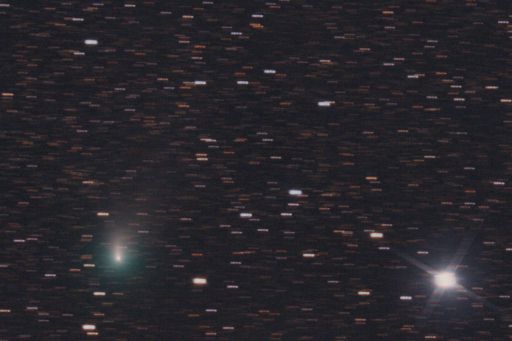
Comet 2014 E2 (Jacques)
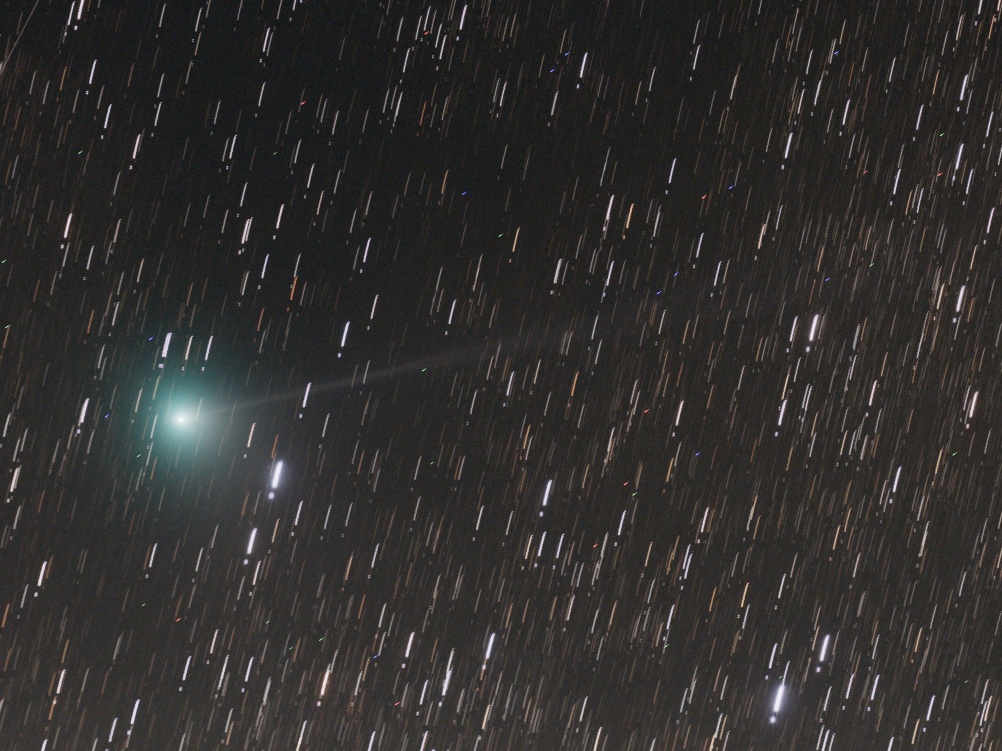
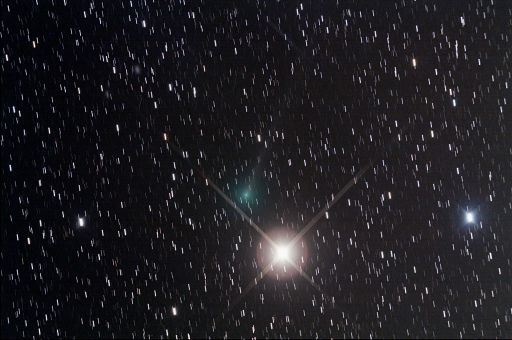
This comet is currently the brightest comet in the sky - being slightly brighter than 7th magnitude and well placed for Northern Hemisphere
observers - moving rapidly through Cassiopeia. The image above was taken by Albert van Duin from his observatory in Beilen, as a first test of
his new 290mm f/2,5 astrograph. It is a stack of 30 30s-images with a modified Canon 5D MKII taken on August 23 between 20h33m en 20h56m UT.
This is a 3x3 binned crop of the original image. The bright star near the comet is 32 Cas.
On the same evening this comet was imaged by Emiel Kempen in Hoogeveen with a 25-cm f/4 Newton equipped with a SBIG ST10XME.
His RGB composite of 5 30s images in each colour can be viewed by clicking here. [August 27, 2014]
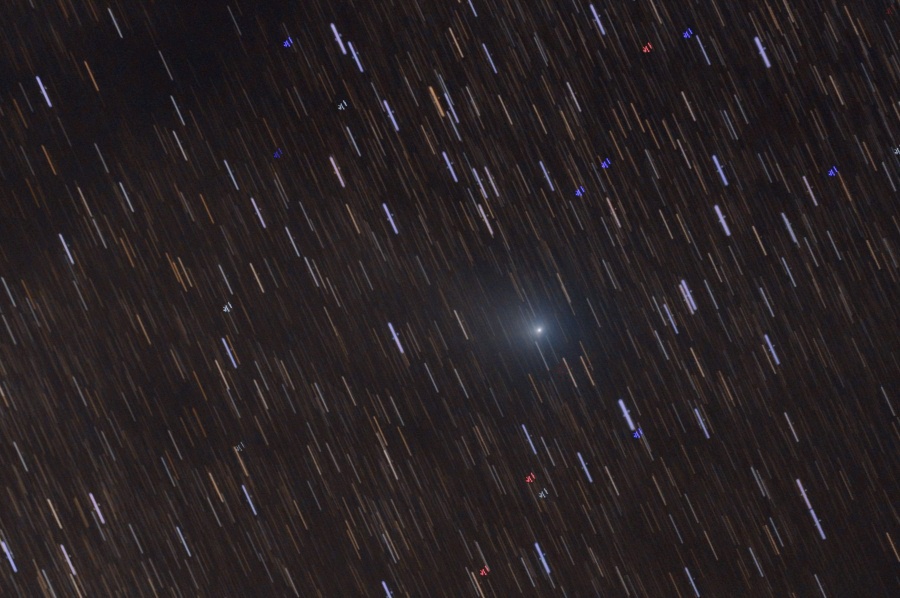
On September 17 between 19h22m and 19h54m UT Albert van Duin imaged the comet again with the same equipment. The image above is a 2x2 binned crop of
a stack of 30 60s images. It is obvious that the comet is clearly past its prime, and is rapidly fading. [Update September 24, 2014]
Some personal memories of
Bill Bradfield (20 June 1927 - 9 June 2014)
|
It is with great sadness that I learned today of the passing away of Bill Bradfield, one of the greatest visual observers of the 20th century,
with 18 credited comet discoveries between 1972 and 2004.
I had the privilege of being a guest to his family twice, in 1983 and 1986, when he took ample time to discuss with me his searching technics,
showing his instruments and most of the locations Northwest and East of Adelaide from where he made his discoveries till then.
What struck me most, apart from his friendly and very modest character, was his meticulous planning and sheer determination to the 'job'.
When I suggested once that he should also try to observe and report visual observations of other comets, now that he was out there anyway
- in those days there were really very few southern observers - he politely declined. That would take time, better spent on covering more sky!
Our third and last meeting was in December 2002 in his new home in Yankalilla, where he moved to around 1995, when I visited him with Georg Comello
after observing the total solar eclipse of December 4. At the time he had made 17 discoveries, but was still searching for comets despite living
now in a poorer climate, and not to forget the stiff competition of the new automated CCD searches of LINEAR, NEAT and the like since the mid to
end nineties.
His perseverence was rewarded 15 month later, when after a nearly nine year drought he finally found his 18th and last comet C/2004 F4
(Bradfield), which developed into a very fine naked eye object for northern hemisphere observers after perihelion passage.
Unfortunately, he never found a really great comet, but this probably is the one that came closest.
Bill, you will be in my heart for the rest of my life.
May you rest in peace.
Reinder Bouma, Groningen, 16 June 2014.
|
|
Naked eye Nova in Delphinus
|
On August 14.584 Koichi Itagaki of Yamagata, Japan, using a 18-cm reflector + CCD found a 'new' 6-7th magnitude object in Delphinus;
24 hours earlier nothing down to magnitude 13 had been visible, so this was very likely a nova. Indeed, early spectroscopy showed that this
was a classical nova, still on the rise.
The image to the left, a crop of a 68s exposure at ISO1600 with a Canon350D and 70mm lens, was taken by Edwin van Dijk on August 14 at
22h10m UT from Burlage, when the brightness was close to magnitude 6.0.
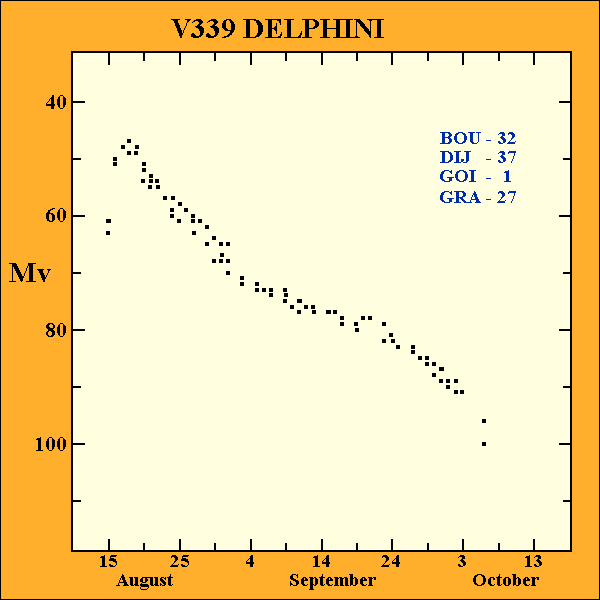
The next night the brightness had increased another magnitude, and it peaked near magnitude 4.5 or slightly brighter around August 16.5.
Thereafter a rather gradual fading set in.
By now (October 7) it has started to fade more rapidly, probably due to the formation of a dustshell around the nova.
Therefore, it is worth to further follow this object closely over the coming weeks!
In the meantime it has received the permanent designation V339 Delphini.
A graph with our observations can be viewed here.
For Northern Hemisphere observers it is the brightest nova since V1494 Aquilae which peaked near magnitude 4.0 in early December 1999...
[Updated October 7, 2013.]
|
|
Bright comet 2011 L4 (PANSTARRS) in evening sky
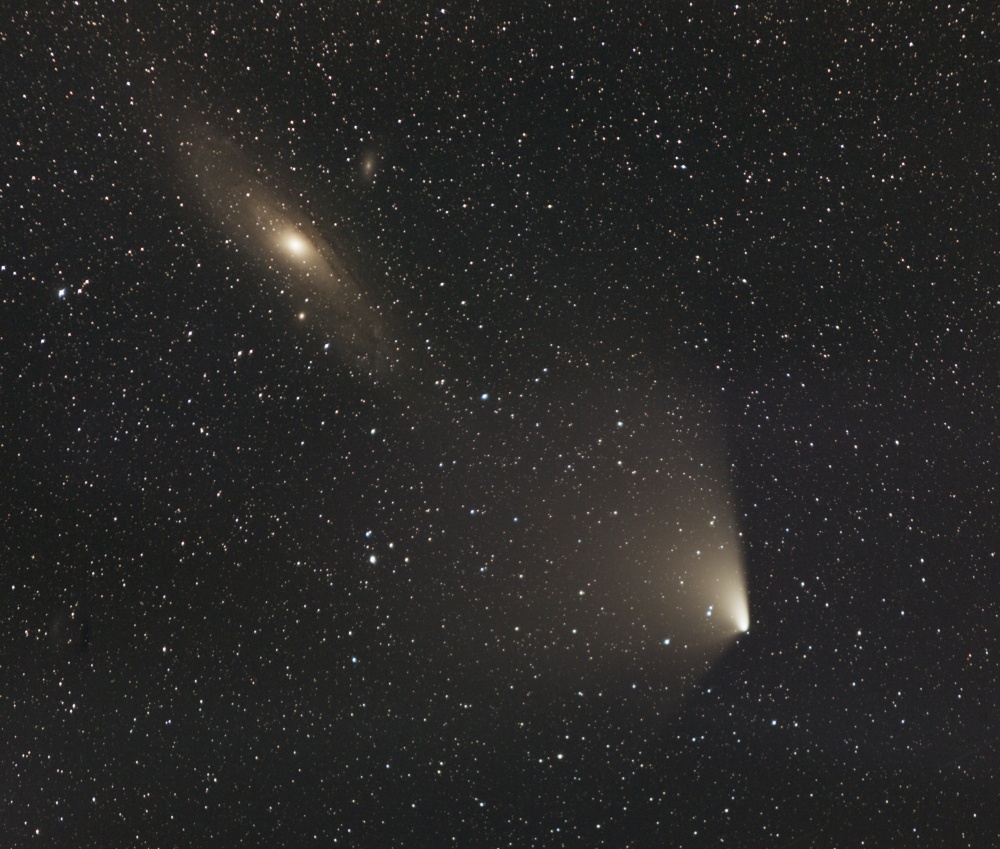
This comet, after performing nicely for southern hemisphere observers en route to perihelion on March 10 at 0.302 AU from the Sun,
was observable from the northern hemisphere both near the end of evening twilight and near the start of morning twilight in early April.
The image above was taken by Albert van Duin from Ewer, a hamlet some 20km NW of Groningen, on the evening of April 2. It is a stack of
30 30s exposures with a 200mm f/2.8 lens on a Canon 5D MkII set at ISO800, taken between 19h57m and 20h17m UT, showing the comet near M31.
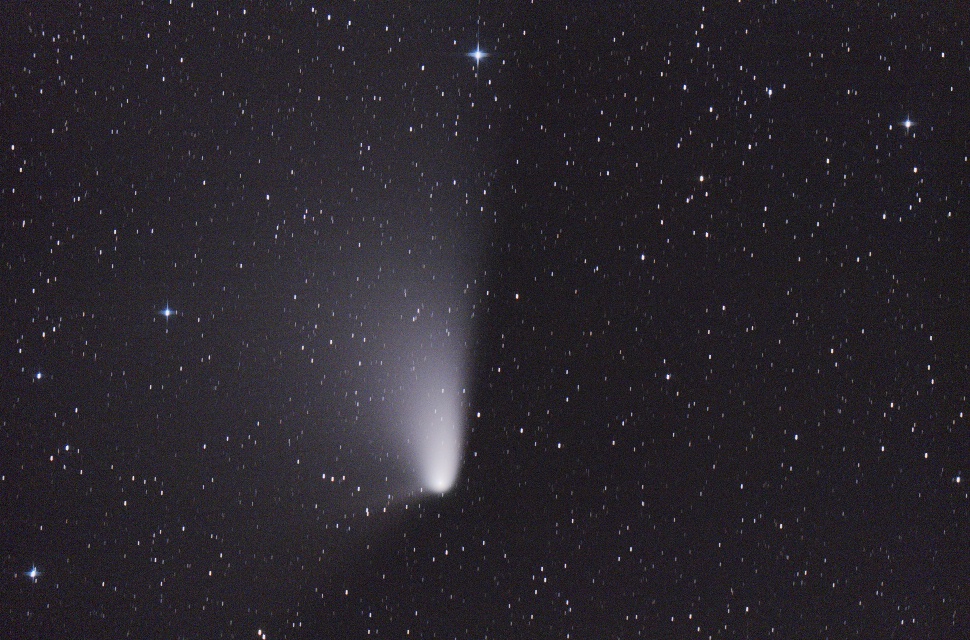
Four days later, on April 6, Emiel Kempen imaged this comet during our semi-annual starparty at Burlage under excellent conditions.
The image above is a stack of 16 20s exposures, taken between 20h26m and 20h33m UT with a 25-cm f/2.9 reflector equipped with a Canon 40D
camera, set at ISO400.
Over the last couple of weeks observing conditions have gradually improved now that it is a circumpolar object for most of the northern
hemisphere. However, after reaching first magn. around perihelion its brightness has decreased rather rapidly, and now it is down to 8th
magnitude. Because of the development of a nice wide fanning dusttail it is still a nice object for both visual and photographic observers.
[Updated 8 May.]
Bright Sungrazer 2012 S1 (ISON) at the end of 2013?
|
This comet was discovered by Vitaly Nevski and Artyom Novichonok with a 40-cm telescope as part of the ISON project as a virtual stellar magn. 19
object with unusual motion on September 21. It was confirmed on the following days by them and others as a clearly cometary object in larger telescopes
and thus received the designation C/2012 S1 (ISON).
It was soon realized, and the first orbit confirmed it, that this was a non-Kreutz sungrazer with perihelion at 0.012 AU on November 28, 2013.
Interestingly, the orbit is somewhat similar to that of the great comet of 1680.
A good summary of the events around the discovery can be found at the cometography website.
There has been a lot of speculation about the maximum brightness around perihelion, and some sources quote a magnitude between magnitude -10 and -15.
These numbers should be taken with more than the proverbial pinch of salt though. Objects with a small perihelion distance are very sensitive to the
brightness development within 1 AU from the Sun; with the same Ho (currently about 5) at 1 AU the difference in brightness at perihelion for this comet
is nearly 10 magnitudes if n is not the 'standard' 4, but only 2. Still, this comet will probably reach negative magnitudes when close to the Sun, and
will very likely be a spectacular object for Northern hemisphere observers postperihelion if it survives perihelion. Definitely to be continued.....
The most recent image to the right was obtained by Albert van Duin from his backyard observatory in Beilen, The Netherlands on March 12, 2013 using a
40-cm f/4.5 reflector, equiped with a QSI583 CCD. It is a stack of 4 180s exposures in 2x2 binning mode taken between 22h08m and 22h24m UT.
The comet is still a rather inconspicuous object, although already showing a short tail, but we expect this will change dramatically over the coming 8-9 months.
|
|
Images of three comets
|
The images to the right were obtained by Albert van Duin from his backyard observatory in Beilen, The Netherlands on October 10, 2012 using a
ASA 20-cm f/2.75 reflector, equiped with a QSI583 CCD, which automatically guided on the head of the comet.
From left to right:
C/2012 J1 (Catalina), stack of 9 180s exposures 19h32m - 20h01m UT
C/2012 K5 (LINEAR), stack of 9 180s exposures 18h58m - 19h27m UT
260P/McNaught, stack of 10 180s exposures 18h19m - 18h49m UT.
|
|
Click here for a larger crop of the original images: C/2012 J1 C/2012 K5 260P.
168P/Hergenrother in outburst!
|
This comet was discovered by Carl Hergenrother in November 1998 in the early days of the Catalina Sky Survey as an inconspicuous 17th magnitude object.
It was duely recovered in 2005 and then received its permanent number 168P. Again, despite being favourably placed it remained rather dim.
The apparition of this year is about the most favourable possible with perihelion close to opposition, but based on its past performance it was not expected to become brighter than about magnitude 14.
So it was a pleasant surprise when visual observers picked it up in early September when most agreed it was about magnitude 12.5-13.
But the best was still to come.
We were quite surprised to find a very strongly condensed object on the evening of September 22, nearly a magitude brighter than three days earlier;
168P was clearly in the early stage of an outburst!
But more importantly, it continued to brighten over the full moon period, and in early October - when it could be observed again in a dark sky -
it was still very condensed and had further brightened to about visual magnitude 9-10, at least 4 magnitudes brighter than anticipated.
|
|
Now almost 3 months past perihelion 168P is clearly fading rapidly. It appears that the outburst , which (as images with large telecopes recently
clearly showed) was the result of a nuclear breakup, is largely over.
This recent image was obtained by Albert van Duin from his backyard observatory in Beilen, The Netherlands on December 13, 2012.
It is a stack of 10 180s exposures taken between 16h36m and 17h08m UT through a 40-cm f/4.5 Newtonian reflector, equipped with a QSI583 CCD
in 2x2 binning mode.
More images of this comet can be viewed here in our 168P image gallery.
[update December 23, 2012.]
Bright comet 2009 P1 (Garradd)
|
This intrinsically bright comet was discovered by Gordon Garradd in the course of the Siding Spring Sky Survey 2½ years ago,
in August 2009. It is now well past perihelion which occurred on December 23 at 1.55 AU from the Sun. Over the coming months it will still be a binocular
object, well placed for Northern hemisphere observers, after reaching a maximum of about magnitude 6½ in February 2012.
The most recent image to the right was obtained by Albert van Duin from his backyard observatory in Beilen, The Netherlands on March 22, 2012.
It is a stack of 30 120s exposures taken between 22h03m and 23h08m UT through a 40-cm f/4.5 Newtonian reflector, equipped with a modified Canon5D MkII set at ISO1000.
More images by Albert van Duin and Emiel Kempen can be viewed here in our C/2009 P1 image gallery.
[update March 23, 2012.]
|
|
The great Christmas comet 2011 W3 (Lovejoy)
|
This comet was discovered by Terry Lovejoy (Thornlands, QLD) as a 12-13th magnitude object om images obtained on 27 and 29 November.
After confirmation on December 1 by other observers a first orbit indicated that this was a Kreutz sungrazer, the first discovered from Earth since 1970.
However, it appeared that its absolute brightness was only marginally greater than that of the brightest sungrazers found in SOHO/LASCO images, so almost
nobody believed that this object would survive perihelion.
So, great was the amazement and exitement when after perihelion, on December 16.012, the comet re-emerged from behind the occultation disk of
the LASCO cameras as a bright stellar object, while the remnants of the preperihelion tail were seen drifting away at the other side of the Sun.
An excellent summary of the events around perihelion as seen by a multitude of solar observing satellites can be read at
Karl Battams' blog here.
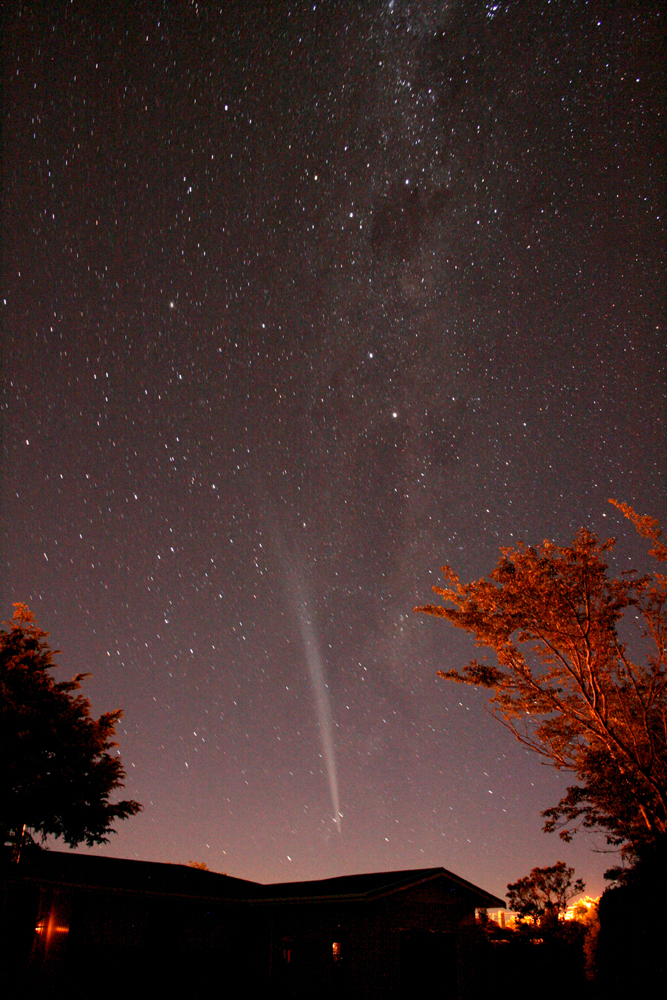
Within a few hours a new tail started to grow, and a few days later earthbound observers in the southern hemisphere were able to see
the tail sticking out of the horizon in bright morning twilight.
Observing conditions improved rapidly afterwards and the comet became a really spectacular sight in the days around Christmas when the Moon had
left the morning sky and the comet could be seen against a relatively dark sky before the start of twilight.
In particular the tail had the shape and high surface brightness so typical for Kreutz sungrazing comets, but the head was very inconspicuous,
and lacking a clear central condensation, rendering accurate astrometry virtually impossible.
The first image to the right was obtained by Rod Austin from New Plymouth, New Zealand on December 24, 15h08m UT.
It is a 75s exposure trough a 18mm lens at f/5.6 at ISO1600.
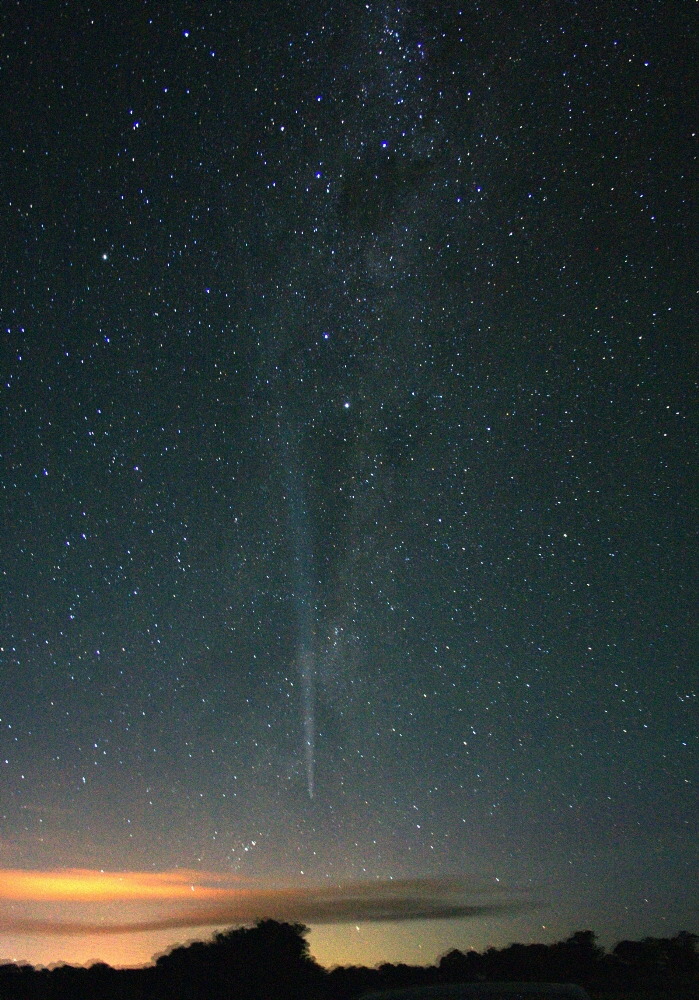
The second image was taken two days later, on December 26.71 UT, by Michael Mattiazzo from Castlemain, VIC.
It is a stack of 10 30s exposures at ISO800 with a Canon 300D and a 18mm lens. The tail can be followed over 38 degrees, although
its surface brightness is clearly fainter than two days earlier.
The two bright stars near the middle of both images are α and β Centauri, while Crux and the Coalsack can be seen near the top.
A series of images received from Graham Wolf shows that the comet could be well imaged with relatively simple digital cameras.
A selection of his images, taken near Turakirae Head - southeast of Wellington, New Zealand - with a Panasonic DMC-LS80 can be viewed by clicking on this image:
In the meantime this comet has virtually faded into the sky background. Maybe it is still possible to catch a last glimp from very dark
locations, but for most observers this object has gone.
|
|
Bright Supernova 2011fe in M101
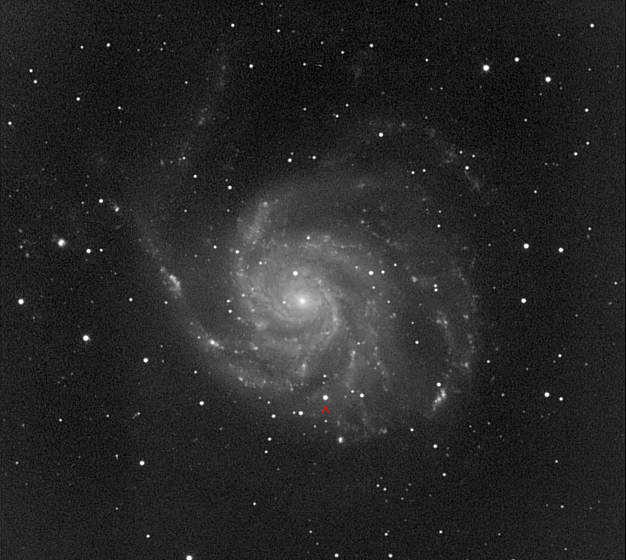
This supernova in nearby M101 was discovered on August 24, 2011 by the Palomar Transient Factory at magnitude 17.
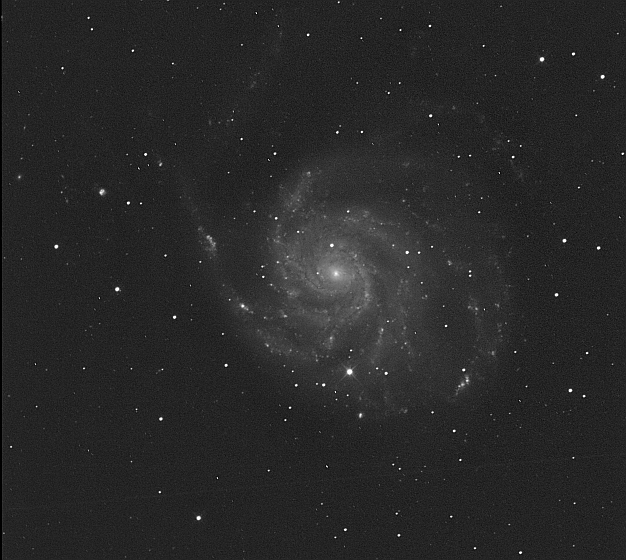
Spectroscopy showed that it was of type Ia in a very early stage, indicating that with an expected maximum brightness near magnitude 10 it might become
the brightest supernova for Northern Hemisphere observers in several decades. The above image on the left shows the SN (indicated with a red arrow)
on the evening of August 27 (stack of 2 120s images), when it had already brightened to about magnitude 12-12.5.
The image to the right (stack of 10 60s images) shows it on September 15 around 19h30m UT near magnitude 10.0, close to or shortly after maximum
brightness. Both images were obtained by Albert van Duin (Beilen, NL) with a 40-cn F/4 Newtonian reflector, equiped with a QSI583wsg CCD camera.
Noctilucent Clouds July 10, 2011
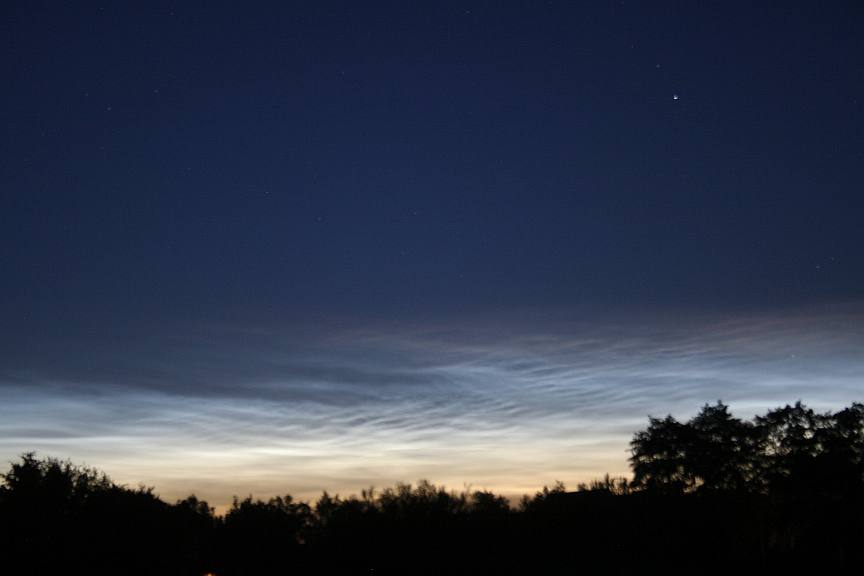
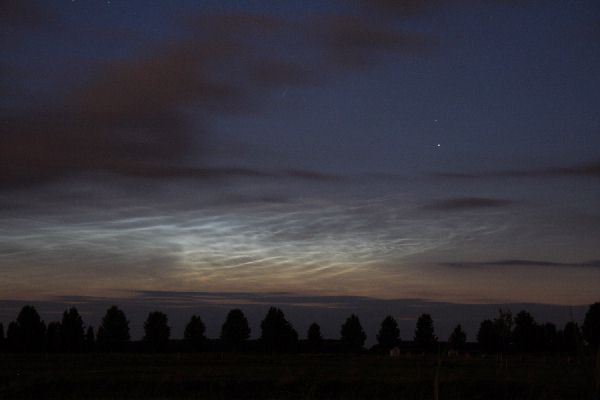
After our observing session of July 9/10 in Burlage we were surprised to see a strong display of NLC
low over the northern horizon.
While I was driving home and enjoying the view, Edwin took the opportunity to make a few photographs.
The image to the right (one of the best of the series) was obtained on July 10 at 00h44m UT.
It is a 13s exposure with a 55mm/f/5.6 lens on a Canon 350D, set at ISO400.
|
|
Very favourable apparition of 103P/Hartley 2 !
|
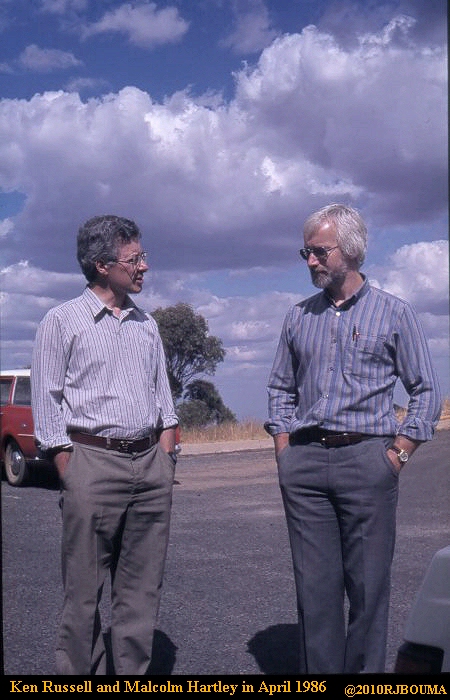
This comet was discovered by Malcolm Hartley on images taken in March 1986 with the 1.2m Schmidt telescope of Siding Spring Observatory.
It was then a 17th magnitude object, already 9 months past perihelion [click here for a 15x15' field from
the DSS discovery plate]. Because of its small perihelion distance near 1.0 AU, due to a close approach to Jupiter in 1971 (0.085 AU),
and another one in 1982 (0.326 AU), it was well observed by visual observers during its rather favourable apparitions in 1991 and 1997/98 when
on both occasions it became a binocular object.
This year's apparition is an extremely favourable one with perihelion (at 1.059 AU from the Sun) on October 28, close to opposition.
103P will approach Earth to 0.121 on October 21. It is then visible all night for Northern Hemisphere observers, after
reaching a maximum declination of +56.8° on October 7.
Over the last weeks the comet has been brightening fairly rapidly to 5th magnitude, but it is still somewhat fainter than expected.
However, it may still reach about magnitude 4.5 at the end of October.
A few observers at very dark locations have been able to spot 103P with the naked eye, but it probably should be easier to see with the naked
eye in the second half of October and in early November as a large diffuse object with a diameter somewhere between 0.5 and 1 degree.
It should be noted though that the full Moon (on October 23) will interfere during the comet's time of closest approach to the Earth.
Also its path through the Milky Way (Auriga and Gemini) during this period will occasionally cause interference from bright stars.
For visual observers we have charts available with proper comparison stars.
|
|
|
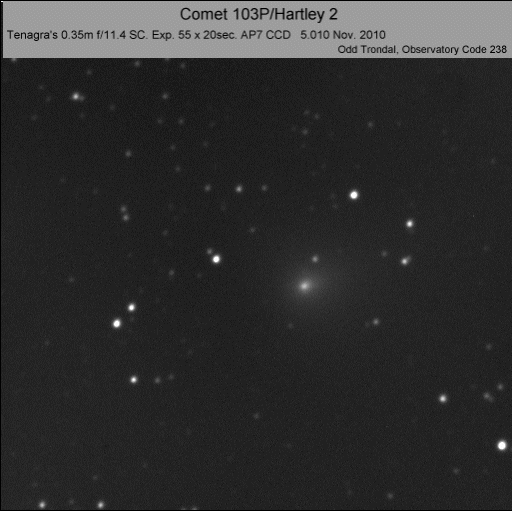
The image to the right was obtained by Odd Trondahl from Oslo, Norway on November 5, 2010.
This was about 12 hours after the succesful passage of the EPOXI spacecraft some 700 km from the nucleus of this comet.
Full details are on the image.
An animated gif from 55 20s images can be viewed here.
More images can be viewed here in our 103P image gallery.
Reinder Bouma, updated November 11, 2010
|
|
Noctilucent Clouds in 2010.
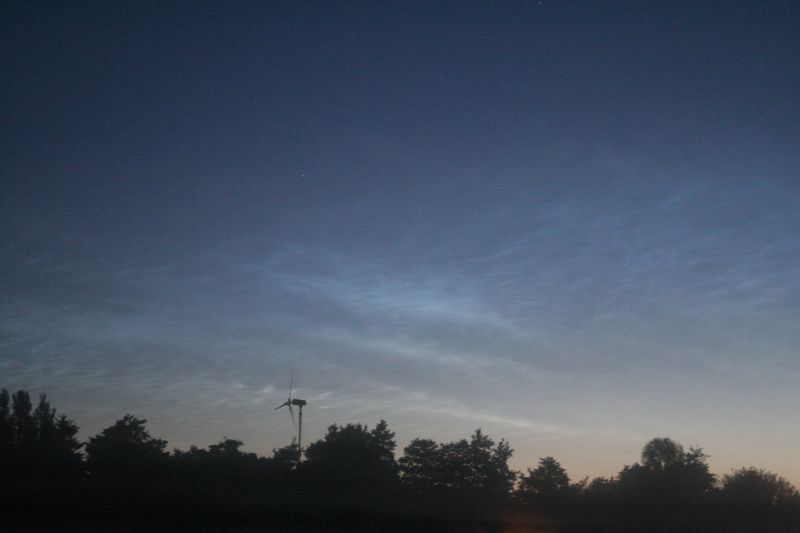
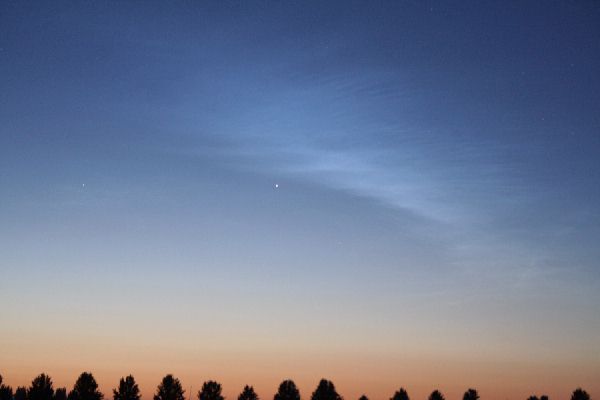
Sofar this year has been a fairly poor one for NLC's with only two minor displays, on June 15/16 and 25/26.
The image to the right was obtained on the evening of June 25 by Edwin near his home in Burlage, Germany.
It is a 1.6s exposure in strong twilight with a Canon 350D, set at ISO1600.
|
|
C/2009 K5 (McNaught)
|
This comet is currently (and over the coming weeks) a nice 8th magnitude object, favourably placed for northern hemisphere observers.
It is moving rather fast to the north through Cygnus and Cepheus, pasing only 6 degrees from Polaris around May 18.
By that time it probably has faded slightly, to about magnitude 9.
The (binned and cropped) image to the right was obtained on April 7, 2010 by Onkar Dixit with the 60 cm f/4 telescope of Triebenberg
Observatory near Dresden, Germany. It is a stack of 30 60s images (10 each in R, G and B).
Click here for the full resolution [4096x4096 pixels, 3 MB download!] image.
|
|
Impact on Jupiter
|
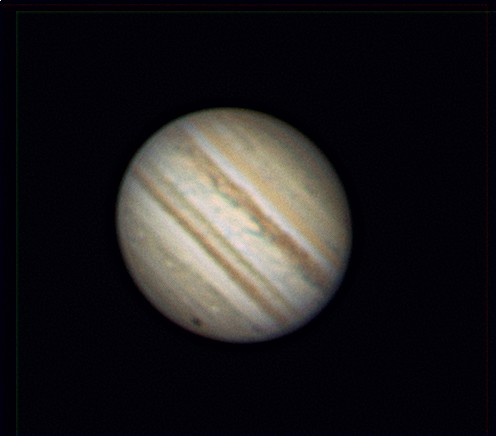
On July 19 Australian amateur Anthony Wesley discovered a deep black scar in Jupiter's southern polar region, which
proved to be another impact site, probably from a rather small comet or asteroid, almost 15 years to the day after the
spectacular impacts of the Shoemaker-Levy 9 fragments.
The image to the right was obtained on July 25, around 02h07m UT by Dutch astrophotographer Jan Koet with an
Astro Physics 180EDT F/9 and Meade Barlow 5000 3x, equipped with a DMK31 camera.
The impact site is well visible near the edge of Jupiter.
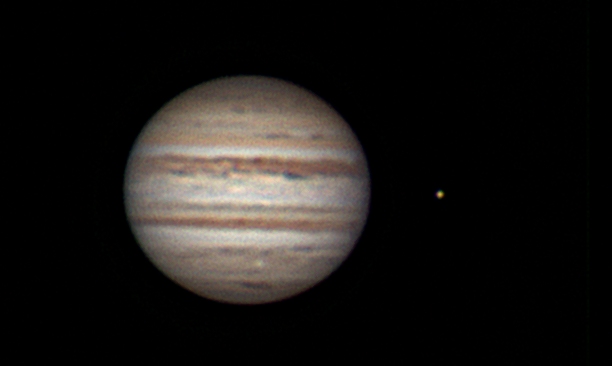
The second image was taken with the same equipment on August 3 around 23h31m UT.
The impact site has now become clearly elongated under the influence of strong Jovian winds.
The satellite to the right is Europa.
In the meantime the impact scar has been spread out further, and has virtually disappeared from view.
|
|
Sarychev Peak sunsets
|
After the fine displays of 'vulcanic' sunsets last year we have been treated again over the last couple of days.
This time they are due to an outburst by Sarychev Peak in Russia on June 12.
Unfortunately, the displays have not been that colourful, but the presence of typical dirty-yellowish bands over the
northwestern horizon shortly after sunset was very obvious. Also a faint purple-reddish hue was faintly visible for
a short while some 20-30 minutes after sunset.
Images of the displays of July 1, 2 and a minor display on the 11th can be viewed here.
|
|
C/2007 N3 (Lulin) on the way out.
|
Comet 2007 N3 (Lulin) now is clearly past its best, but is still favourably placed in the evening sky
(although rapidly fading) over the coming weeks for both northern and southern hemisphere observers.
The image to the right was obtained by Albert van Duin, Beilen, The Netherlands on March 17, 2009.
It is a stack of 30 120s exposures taken between 19:01 and 20:07 UT, with a modified
Canon 40D, set at ISO800, through a 20-cm f/2.75 ASA astrograph.
Click here for the full resolution image.
|
|
29P/Schwassmann-Wachmann 1 unusually active.
|
Since becoming visible in the morning sky in September 2008 29P has been unusually active. Several big outbursts
made it at times as bright as 10th magnitude, and up till now it has been observable visually continuously. Which as
far as I can remember is unprecedented. It is now well placed in the evening sky in Gemini, and observable for
both northern and southern hemisphere observers.
The image to the right showing several jet-like stuctures was obtained by Albert van Duin, Beilen, The Netherlands on January 30, 2009.
It is a stack of 30 120s exposures taken between 21:54 and 23:02 UT, with a modified
Canon 40D, set at ISO1600, through a 20-cm f/2.75 ASA astrograph.
|
|
144P/Kushida is bright!
|
During December 144P/Kushida brightened much faster than anticipated, and is now easily visible in larger
binoculars as a large diffuse object of about magnitude 8½. Over the coming weeks it will probably start
fading slowly. It is now well placed in the evening sky for both northern and southern hemisphere observers.
The image to the right was obtained by Albert van Duin, Beilen, The Netherlands on January 24, 2009.
It is a stack of 13 120s exposures taken between 22:36 and 23:05 UT, with a modified
Canon 40D, set at ISO1600, through a 20-cm f/2.75 ASA astrograph.
Click here for the full resolution image.
|
|
C/2008 T2 (Cardinal) slowly brightening.
|
Currently C/2008 T2 is still slowly brightening, only visible with large telescopes at about magnitude 12½, but over the
coming months it is expected to brighten to magnitude 9-10 around the time of perihelion in June 2009. During this time
it is best visible for northern hemisphere observers being well placed high in the evening sky.
The image to the right (shown at full resolution) was obtained by Albert van Duin, Beilen, The Netherlands on December 27, 2008.
It is a stack of 20 120s exposures taken between 21:07 and 21:52 UT, with a modified
Canon 40D, set at ISO1600, through a 20-cm f/2.75 ASA astrograph.
|
|
Comet 2006 OF2 (Broughton)
|
Over the coming months comet 2006 OF2 (Broughton) is still very favourably placed for
northern hemisphere observers. During December it continued to brighten and is currently about magnitude 10.
The image to the right was obtained by Albert van Duin, Beilen, The Netherlands on December 27, 2008.
It is a stack of 20 120s exposures taken between 22:37 and 23:24 UT, with a modified
Canon 40D, set at ISO1600, through a 20-cm f/2.75 ASA astrograph.
Click here for the full resolution image.
|
|
Comet 2006 W3 (Christensen)
|
Comet 2006 W3 (Christensen) continued to brighten over the last couple of month,
and is already 10th magnitude with still over 8 months to go to perihelion! It is currently very favourably placed for
northern hemisphere observers.
The new image to the right was obtained by Albert van Duin, Beilen, The Netherlands on October 22, 2008.
It is a stack of 10 180s exposures taken between 18:03 and 18:36 UT, with a modified
Canon 40D, set at ISO1600, through a 20-cm f/2.75 ASA astrograph.
Click here for the full resolution image.
|
|
Kasatochi sunsets
|
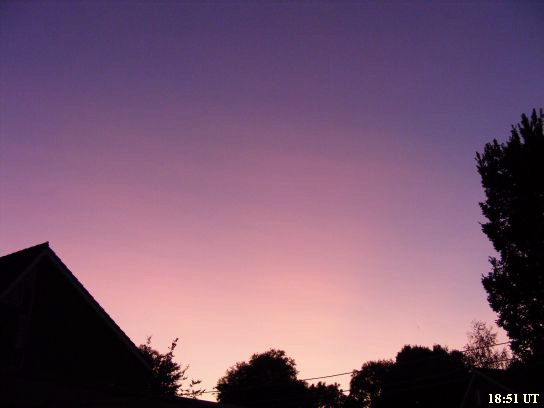
On the evening of August 30, 2008 we witnessed a colourful sunset thanks to material trown high up in the atmosphere
in a recent outburst of Kasatochi, a vulcano on one of the Aleutian islands.
The image to the right shows the display at its peak around 18h50m UT. The show started shortly before local sunset when rather suddenly
banded clouds, looking like a cross between cirrus and noctilucent clouds, appeared over the western horizon. Over the next 30 minutes these
bands gradually changed colour, first to a yellowish, then reddish hue, until around 18:45 - 18:50 UT the whole western sky showed bright
red to purple colours.
After 18:50 UT however, the colours started to disappear quickly and shortly after 19:00 UT the show was over, and the sky had cleared
again, as if nothing had happened....
Another, minor display was observed on September 13.
Images of both displays can be viewed here. (updated 16/09)
|
|
Two Boattinis
|
In the night of 1/2 September Albert van Duin imaged both Boattini comets with his 20-cm f/2.75 ASA astrograph from Puimichel in southern France.
The first image to the right is of C/2007 W1, which at 10th magnitude was well passed its maximum brightness.
It is a stack of 7 420s exposures taken between 1:21 and 2:34 UT, with a modified Canon 40D, set at ISO800. The
comet was located close to α Arietis (Hamal).
Click here for the full resolution image.
The second image is of C/2008 J1.
It is a stack of 8 420s exposures taken between 23:55 and 1:18 UT, with a modified Canon 40D, set at ISO800.
Click here for the full resolution image.
This comet is currently fading from its maximum brightness, and now (end of October) only 12th magnitude.
It is very favourably placed for northern hemisphere observers. Over the coming month it will continue to move slowly,
close to Polaris.
|
|
Distant comet 2005 L3 (McNaught)
|
This month (June 2008) distant comet 2005 L3 (McNaught) with q = 5.593 AU is still favourably placed in Serpens
starting to fade from its maximum brightness of about magnitude 13-13.5.
The image to the right was obtained by Albert van Duin, Beilen, The Netherlands on May 10, 2008.
It is a stack of 10 300s exposures taken between 21:54 and 22:47 UT, with a modified
Canon 40D, set at ISO800, through a 20-cm f/2.75 ASA astrograph.
Click here for the full resolution image.
|
|
46P/Wirtanen at its brightest
|
46P/Wirtanen had a favourable evening apparition in the first 4 months of this year, peaking near magnitude 8.5 in February.
The (cropped and binned) image to the right was obtained by Albert van Duin, Beilen, The Netherlands on February 8, 2008. It is a stack of 12 180s exposures taken between 18:32 and 19:11 UT, with a modified
Canon 350D, set at ISO800, through a 20-cm f/2.75 ASA astrograph.
Note the faint tail pointing up and slightly to the right.
Click here for the (cropped) full resolution image.
|
|
New comet 2008 C1 (Chen-Gao)
|
This magnitude 13 comet was found by Tao Chen on an image taken by Xing Gao on February 1
with a Canon 350D, equipped with a 200mm f/2.8 lens, as part of a nova search, and subsequently also
identified on images of January 30 and 31. Further confirming images were obtained on February 2, after which
the first amateur discovery of 2008 received the designation 2008 C1 (Chen-Gao).
Preliminary orbital calculations show that this comet will pass perihelion on April 16 at 1.26 AU
from the Sun. Recent observations suggest that it will gradually brighten to about magnitude 10 or slightly brighter by the end of March, being
favourably placed in the evening sky for northern hemisphere observers. After perihelion it is better
placed for southern observers, albeit at a rather small elongation around 50 deg., and gradually fading.
The (cropped) image to the right, showing the comet close to 4 Cas and M52 as an inconspicuous greenish spot,
was obtained by Albert van Duin, Beilen, The Netherlands on February 4, 2008. It is a stack of 6 180s exposures taken between 18:47 and 19:07 UT, with a modified
Canon 350D, set at ISO800, through a 20-cm f/2.75 ASA astrograph.
Another image, taken two days later, can be viewed here.
It is a stack of 8 180s images, taken with the same equipment on February 6, 2008 between 18:40 and 19:07 UT.
His most recent image can be viewed here.
It is a stack of 10 180s images, taken with the same equipment on February 27, 2008 between 21:17 and 21:49 UT.
|
|
Faint comet 2006 S5 (Hill)
|
C/2006 S5 (Hill) was a faint comet peaking near a maximum brightness of about magnitude 13.5 in January 2008, favourably placed near the
boundary between Gemini and Cancer.
It is a distant comet with q = 2.630 AU and a relatively short period of about 960 years.
The (cropped) image to the right was obtained by Albert van Duin, Beilen, The Netherlands on December 16, 2007. It is a stack of 12 300s exposures taken between 00:33 and 01:36 UT, with a modified
Canon 350D, set at ISO800, through a 20-cm f/2.75 ASA astrograph.
Despite its large heliocentric distance it has a rather obvious tail, some 5' long.
Another, more recent image by Albert van Duin can be viewed here.
It is a stack of 30 180s images, taken with the same equipment, but at 1600ISO, on January 12, 2008 between 21:38 and 23:14 UT.
|
|
The discovery of V597 Puppis
|
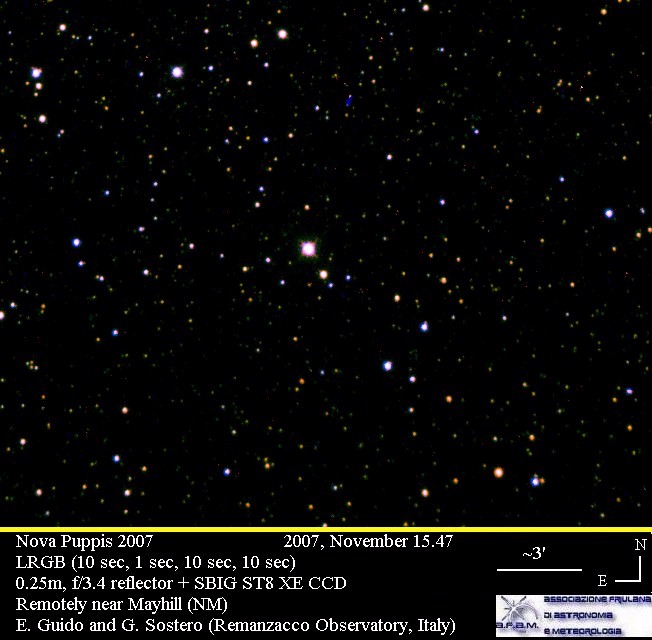
In the early morning of November 14, 2007 our longtime friend Alfredo Pereira, observing from his home at Cabo da Roca, Portugal,
discovered his 4th nova at magnitude 7 in Puppis. It was quickly confirmed by other observers and received the permanent designation V597 Puppis.
It appears to belong to the class of fast novae; follow-up observations by Alfredo indicate a drop in brightness of over 2 magnitudes within 4 days of maximum.
The image to the right shows the new intruder (the bright reddish object near the center) in Puppis. It was imaged remotely from New Mexico by Ernesto Guido
and Giovanni Sostero just over a day after discovery.
Unfortunately, at decl. -34o it is too far south to be observable from our latitude.
Alfredo has been so kind to write up his discovery story for us, together with some additional information
about his nova search efforts. You can download his article as a pdf here.
|
|
Favourable apparition of 8P/Tuttle
|
Currently (23 February) 8P is moving southeast through Horlogium towards Reticulum, thus being best visible
from the southern hemisphere.
The comet is now fading and still large, and fairly diffuse, due to its close approach to the Earth in early January.
The (cropped) image to the right was obtained by Albert van Duin, Beilen, The Netherlands on the evening
of December 29, 2007. It is a stack of 15 120s exposures taken between 17:57 and 18:29 UT, with a modified
Canon 350D, set at ISO800, through a 20-cm f/2.75 ASA astrograph. Note the faint downward (east) pointing tail!
More images by Albert van Duin and Emiel Kempen can be viewed here in our 8P image gallery.
[last updated 08/01/2008]
|
|
17P/Holmes in outburst!
|
On October 23/24 P/Holmes stunned observers by going into outburst, increasing by a full 14 magnitudes
within 24 hours, from an inconspicuous 16th magnitude to an easy naked eye object of about magnitude 2.5,
disturbing the familiar pattern of the stars in Perseus! Over the following week the total magnitude remained about the same, but 17P
transformed from nearly stellar, to a huge object, resembling a planetary nebula of about 9' diameter (actually the dust coma),
surrounded by a very faint gascoma reaching almost 1 degree in diameter.
In the meantime the gascoma has completely disappeared, but the dustcoma has increased considerably,
reaching almost 1.5 degree in diameter by the end of December. The surface brightness of the comet has decreased considerably,
but the total brightness has decreased very little. As a consequence, the increasing size has made visual estimates
and the choice of a proper instrument more and more difficult.
After almost a week of cloudy weather the skies over The Netherlands finally cleared and some
of our regular contributors of photographs managed to catch it, at last.
The images to the right were obtained on the evening of 30 October, 2007 by Albert van Duin from his
backyard observatory in Beilen, The Netherlands.
The first image, processed to better bring out the gas component of the coma, is the sum of 49 5s-exposures taken between 18h39m and 18h59m UT with a modified Canon 350D,
set at ISO800, through a 20-cm f/2.75 ASA astrograph.
This is a 2x2binned image from the original.
Click here for a (cropped) full resolution image.
The second image was processed to emphasize the details in the dust coma.
This is a 2x2binned image from the original.
Click here for a (cropped) full resolution image.
More images by Jean-Marie Biets, Albert van Duin, Edwin van Dijk, Carl Johannink,
Emiel Kempen and Marco Langbroek can be viewed here in our 17P image gallery.
[last updated 29/02/2008]
|
|
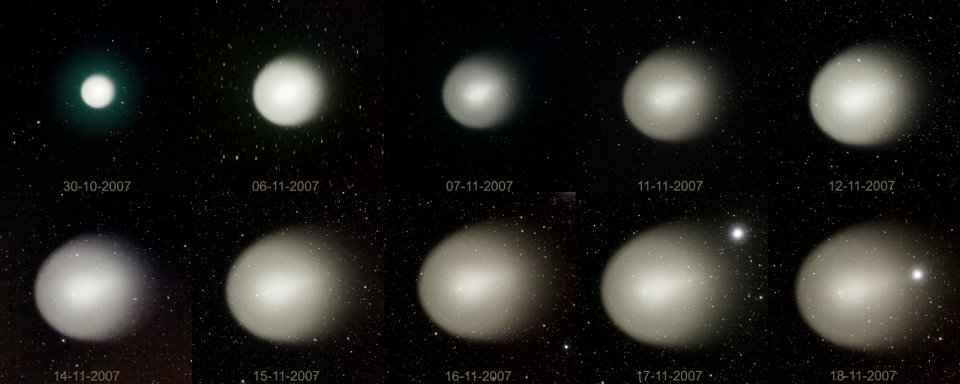
The following sequence, prepared by Emiel Kempen, nicely shows the expansion of the dust coma
between October 30 and November 18.
C/2006 VZ13: a fine summer comet
|
Comet 2006 VZ13 (LINEAR) passed close to the bright globular cluster M3 on the evening of July 22, 2007. This event was imaged by Albert van Duin from his
backyard observatory in Beilen, The Netherlands.
The first image shows the rapid motion of the comet in the course of 25 minutes.
It is the sum of 34 30s-exposures taken between 21h40m and 22h05m UT with a modified Canon 350D,
set at ISO1600, through a 20-cm f/2.75 ASA astrograph.
This is a 2x2binned image from the original.
Click here for a (cropped) full resolution image.
The second image was obtained from the same data set, but now centered on the comet.
This is a 2x2binned image from the original.
Click here for a full resolution image.
|
|
|
The following two images show C/2006 VZ13 on the evening of July 14.
The first image was obtained by Albert van Duin from his backyard observatory in Beilen, The Netherlands.
It is the sum of 40 30s-exposures taken between 21h56m and 22h27m UT with a modified Canon 350D,
set at ISO1600, through a 20-cm f/2.75 ASA astrograph.
This is a 2x2binned image from the original.
Click here for a (cropped) full resolution image.
The second image was taken by Emiel Kempen from Hoogeveen, The Netherlands.
It is the sum of 7 120s-exposures taken between 22h14m and 22h47m UT with a modified Canon 350D,
set at ISO1600, through a 15-cm f/5 Meade Schmidt-Newton telescope.
This is a 2x2binned image from the original.
Click here for a full resolution image.
|
|
Noctilucent Clouds 28 and 29 June 2007
During the month of June there have been several fine displays of noctilucent clouds,
but unfortunately our weather was not really cooperative.
However, Edwin managed to get a few images recently when conditions were not too bad.
The first image to the right was obtained on June 28 at 23h17m UT.
It is a 20s exposure with a 55mm/f/5.6 lens on a Canon 350D, set at ISO800.
The second image was taken on June 29 in strong twilight at 22h01m UT.
It is a 6s exposure with the same equipment and settings.
(All images ©2007EdwinvanDijk)
More images of NLC can be found in the pictures section. |
|
Comet 2007 E2 (Lovejoy).
|
Comet 2007 E2 (Lovejoy) is now out of reach of visual observers, but was a nice binocular object in April and early May 2007.
The images to the right were obtained on the evening of 17 May, 2007 by Albert van Duin from his
backyard observatory in Beilen, The Netherlands.
The comet was then passing only 10' from magnitude 11 NGC6015.
The first image, centered on the comet, is the sum of 30 120s-exposures taken between 21h39m and 22h47m UT with a modified Canon 350D,
set at ISO1600, through a 20-cm f/2.75 ASA astrograph.
This is a 2x2binned image from the original.
Click here for a (cropped) full resolution image.
The second image, centered on the stars, clearly shows the fast motion of the comet past NGC6015.
This is a 2x2binned image from the original.
Click here for a (cropped) full resolution image.
More images by Albert van Duin and Emiel Kempen can be viewed
here in our C/2007 E2 image gallery.
|
|
C/2006 P1 (McNaught), the Great Comet of 2007.
|
Observations of C/2006 P1 over the last week before perihelion showed that this comet continued its rapidly brightening trend all the way,
following a formula close to Ho = 5.0 and n = 4.
Unfortunately, the elongation then was only about 5-6 degrees, but comet McNaught could still be seen by
earth-based visual observers, because the geometry was favourable for a considerable brightness
increase due to forward scattering of sunlight on very small dust particles in the coma.
Dr. Joseph N. Marcus, former editor of Comet News Service, has studied the conditions for forward
scattering in this particular case using a novel Henyey-Greenstein function forecast model, details
of which can be found in an article that has appeared in the special April 2007 issue of the ICQ.
His study showed that an increase in brightness of about 2.5 magnitudes could be expected at the time that the
minimum scattering angle θ was reached on January 14.3. Indeed the many positive observations in broad daylight
close to the sun both with telescopes of various sizes and even with the naked eye indicate that comet McNaught peaked very close to the predicted maximum at magnitude -5 or slightly brighter.
Dr. Marcus (updated) prediction can still be downloaded here.
|
|
After perihelion comet McNaught became a spectacular object for southern hemisphere observers. By the time it became visible
in a fairly dark sky around January 19, observers were stunned by the amount of detail visible in the tail.
Even to the naked eye numerous synchrones or striations were visible in a widely fanning tail. The brighter, southern part could be
followed over at least 25 degrees, while the northern part fanned out to well beyond Fomalhaut reaching a length of
at least 40 degrees, making this part visible at the end of evening twilight as far north as the Netherlands and Germany.
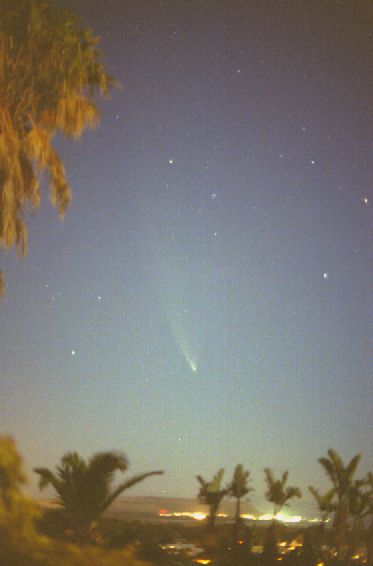
Towards the end of January the comet was still a nice view, despite increasing moonlight, as can be seen on the image to the right.
It was taken on January 28.8 from Noordhoek, Western Cape, RSA. It is a 15s exposure with a 50mm f/1.2 lens on Fujichrome 400 ASA colourfilm.
(©2007rjbouma).
A brief report with images, most of them taken by Boelie Boelens, of our trip to South Africa, can be viewed here.
|
 |
Strange comet P/2006 U1 (LINEAR).
|
On October 19 the LINEAR team discovered a very odd looking comet. Although the head was
perfectly stellar near magnitude 17, it showed a distinct tail, several arcminutes long.
With a perihelion distance of 0.51 AU and a period of 4.63 years it proved to be another member
of the growing class of objects in Apollo/Amor type orbits that mark the transition between
active periodic comets, and dead nuclei that cannot be distinguished from asteroids anymore.
The image to the right was obtained on November 26, 2006 by Albert van Duin from his backyard
in Beilen, The Netherlands.
It is the sum of 14 60s-exposures taken between 21h51m and 21h12m UT with a modified Canon 350D,
set at ISO1600, through a 20-cm f/2.75 ASA astrograph. The field is slightly over 30x30'.
The faint tail can be followed over more than 30' because of the favourable geometry close to
orbital plane passage.
This is a 2x2binned image from the original. Click here
for a full size image.
|
|
Comet 2006 M4 (SWAN).
|
Comet SWAN has now disappeared in evening twilight for both northern and southern hemisphere observers.
The image at right shows the comet close to bright ζ Aquilae.
It was taken on November 18, 2006 between 17h15m and 17h31m UT by Albert van Duin from his backyard in Beilen, The Netherlands.
It is the sum of 23 30s-exposures with a modified Canon 350D, set at ISO1600, through a 20-cm f/2.75 ASA astrograph.
This is a 2x2binned image from the original. Click here for a full size image.
Here you can find a selection of older images.
|
|
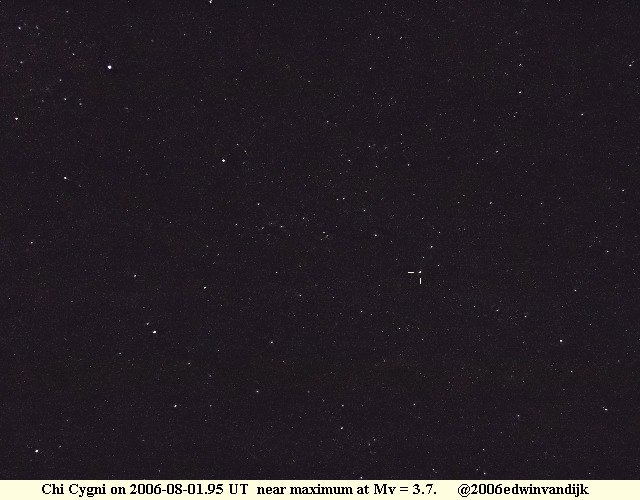
Bright maximum of Chi Cygni.
In early August 2006 the well known mira variable χ Cygni had a very bright maximum near visual
magnitude 3.7, making it an easy naked eye object.
This is a rather unique event; χ had not been this bright for almost 150 years!
The image to the right was taken on August 1 around 22h45m UT; it is a 10s exposure, showing stars down
to 7th magnitude.
Most of the constellation of Cygnus is visible with bright Deneb at upper left.
(Image on Minolta dimage 7i, ©2006EdwinvanDijk)
|
|
The second, much deeper image was taken on the morning of August 4, around 3h45m UT by
Juan José González at the Alto del Castro - Aralla, León at 1720m altitude.
It is a 2m exposure on Fuji Superia 1600 film with a Nikkor 50mm f/1.8 lens.
Chi is the bright orange star near the bottom of the image, slightly left of centre.
Visually it was estimated at magnitude 3.8.
|
|
73P/Schwassmann-Wachmann 3, fragment C.
Romke Schievink and Carl Johannink took this image of 73P-C on May 4, 2006 around 23h40m UT near Gronau, Germany.
This 80s exposure was taken with a Canon 300D body and 475mm F/3.8 Wright-Väisälä camera.
The conditions were far from ideal; there was some moonlight present, and the sky was rather hazy.
Conjunction Moon, Venus and Mercury.
While being in the south of France to witness the effects of Deep Impact on 9P/Tempel 1
(which were rather disappointing for visual observers), we were also able to observe the beautiful
conjunction of the Moon, Venus and Mercury on the evening of July 8, 2005.
By sheer coincidence it was visible from the country road next to our holiday home near
Revest-du-Bion, with (in)famous Mont Ventoux, some 25 km away, in the foreground.
(Image on Minolta dimage 7i, ©2005EdwinvanDijk)
|
|
Romke Schievink and Carl Johannink took this image of C/2002 T7 (LINEAR) on the evening of February
19, 2004 at the COSMOS Public Observatory near Lattrop, The Netherlands. The roughly 1.5 x 2.5 deg.
field nicely represents the view in medium sized binoculars. This 30s exposure was taken around
18h40m UT with a Canon 300D body and 475mm F/3.8 Wright-Väisälä camera.
The bright star in the lower right corner is 86 Pegasi.
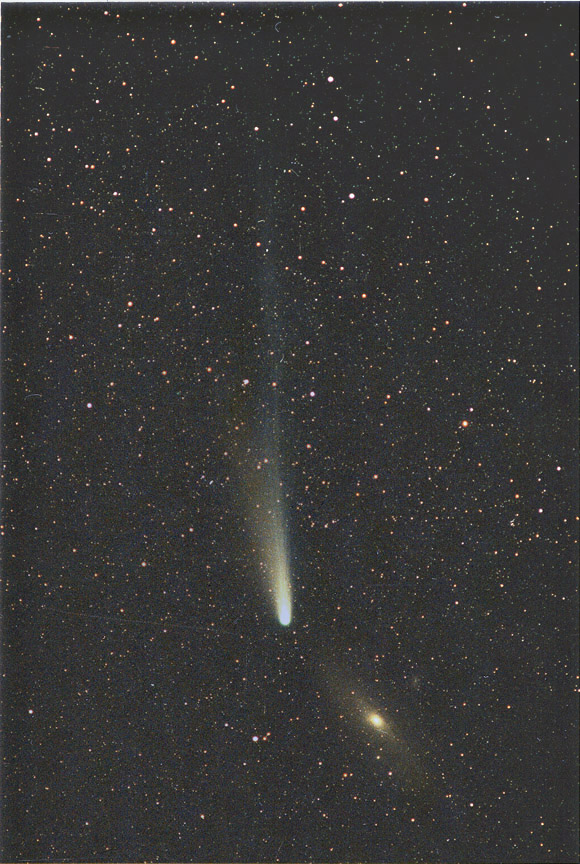
This image of 153P/Ikeya-Zhang and M31 was obtained by
Albert van Duin (Beilen, NL) on the morning of April 5,
2002; it is a 4m exposure with a 200mm f/2.5 lens on
Fujicolor 800 film.

Click here for a full size image [214Kb].
(Old image replaced with an improved copy [24-10-2006].)

And click here for more images of 153P.
|
|
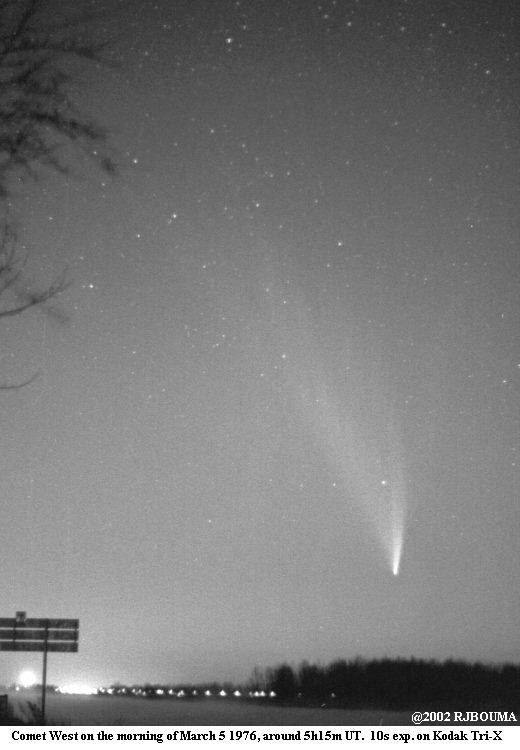
Comet West was a brilliant object in the morning sky
in early March 1976. This image was obtained with a
simple 35mm camera + 50mm f/1.8 lens on a tripod.

Click here for a full size image [41Kb]. |
|